Why Is Africa's Green Jobs Boom Not Happening Yet?
By Vincent Egoro|
I want to start with a number, because the number is the most honest way into this argument.
Africa's entire renewable energy sector employed approximately 324,000 people as of the most recent count. The FSD Africa and Shortlist Forecasting Green Jobs in Africa report, produced with analysis from the Boston Consulting Group and published in July 2024, projects that Africa's green economy could create 3.3 million direct jobs by 2030, with up to 2 million of them in renewable energy and 1.7 million in solar alone. The Mastercard Foundation's Africa Youth Employment Outlook 2026 estimates that more than ten million young people are entering the continent's labour market every year.
I have spent enough time in this space to know that this kind of gap is rarely what it first appears. It looks like a capacity problem, and presents as a financing problem, but what it almost always is, at its core, is a systems problem: a failure to connect the thing that exists in abundance with the thing that needs it, because the infrastructure designed to make that connection was built for a different economy.
Africa's youth population is not the problem, and neither is the energy demand. What is failing is the training architecture designed to turn available young people into employed energy workers.
The paradox in the same labour market
The clearest evidence that this isn't a shortage of willing workers is the fact that unemployment and unfilled vacancies are occurring in the same countries, at the same time, often in the same cities.
In South Africa, Statistics South Africa's first-quarter 2026 Quarterly Labour Force Survey found youth unemployment at 60.9 percent for those aged 15 to 24, and 40.6 percent for those aged 25 to 34. Of the young South Africans who are employed, only 9.1 percent hold technician-level occupations. Most are working in trade, elementary occupations, and services, not the higher-skilled technical roles that a renewable energy buildout requires. More than four in ten young South Africans aged 15 to 34 were not in employment, education, or training at all in the first quarter of 2026.
And yet South Africa's FSD Africa projection puts the country's potential green job creation at between 85,000 and 275,000 by 2030, with the solar sector alone generating up to 140,000 of those roles. Kenya, where youth unemployment among 15 to 34 year-olds exceeds 67 percent according to labour market research compiled by Edstellar, already sources more than 90 percent of its electricity from renewable energy, proof that the underlying technical and institutional capacity to run renewable systems exists. Kenya's solar sector alone is projected to generate 111,000 jobs by 2030 under the FSD Africa modelling. The jobs are coming, but there are no trained people.
Most times when this paradox is discussed, the argument is often for more TVET, more university places, or private sector training partnerships. While all of these things are true, they aren't the complete solution, because none of them addresses the specific question of where the training gets pointed, which is a different question from how much training gets done.
Why the training pipeline keeps missing the target
Only 9 percent of young Africans had completed tertiary education as of 2025, according to the Mastercard Foundation's Outlook. That is the right data point to start with, and I don't want to minimise what it implies about the scale of the foundational challenge. But the deeper problem is not simply too little education, but an education aimed at the wrong part of the system.
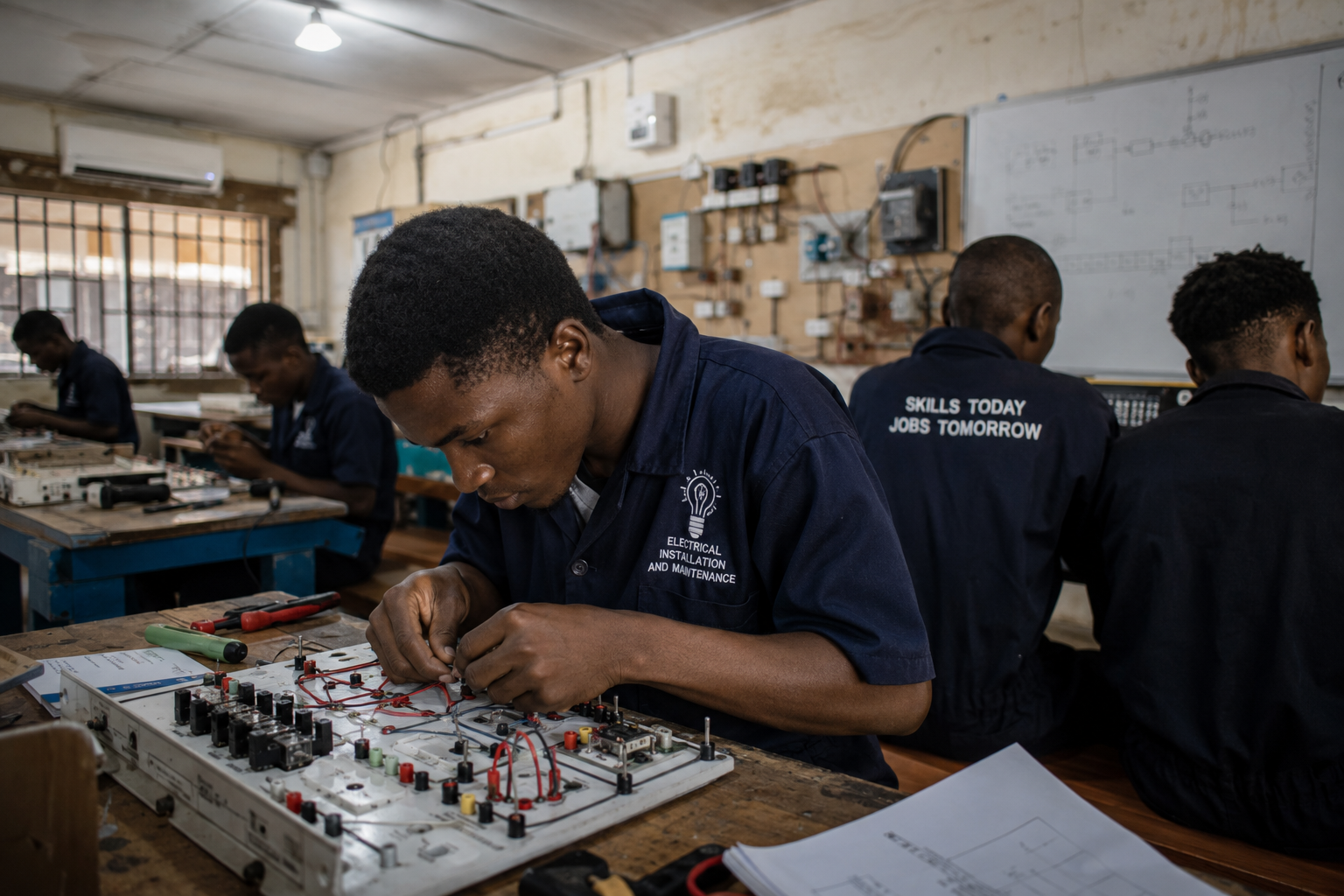
Across Africa, training pipelines in the renewable energy sector are overwhelmingly focused toward installation: people who can mount a solar panel, wire a residential system, and complete a project physically. This is a real and necessary skill, and it is genuinely underprovided in many markets. But it isn't the only skill the renewable energy economy needs, and it isn't the skill category where the most acute shortages are being felt.
An April 2026 report from the Bloomsbury Intelligence and Security Institute identified the operational workforce gap, grid planners, protection engineers, high-voltage specialists, system operators, and dispatch coordinators as one of the most significant constraints on renewable energy integration across African electricity systems. I have written about this in the context of Nigeria's grid collapse pattern, where the gap between installed infrastructure and the people qualified to run it has produced a system that collapses repeatedly, not because of what is missing from the hardware but because of what is missing from the human layer operating it.
The Project Management Institute, in research published in April 2026, projects a 57 percent shortfall in construction and infrastructure project professionals across sub-Saharan Africa by 2035, concentrated specifically in planning, integration, and operational roles. IRENA's Call to Action on Skilling for the Energy Transition, presented at its assembly in January 2026, reached the same diagnosis from a different angle: the most acute shortages sit in specialised technical functions, not general labour supply.
Three separate institutional assessments arriving at the same finding within a single year should have redirected where the training money goes, but to a significant degree, it hasn't. The dominant message directed at Africa's young people who want to work in energy remains overwhelmingly that they become a solar technician. That is a real pathway and a useful one, but it is also an incomplete answer that leaves the operational half of the workforce unbuilt.
A surge of panels, and an industry underneath it not yet formed
There is a live version of this opportunity slipping past in real time, and it is visible in the import data.
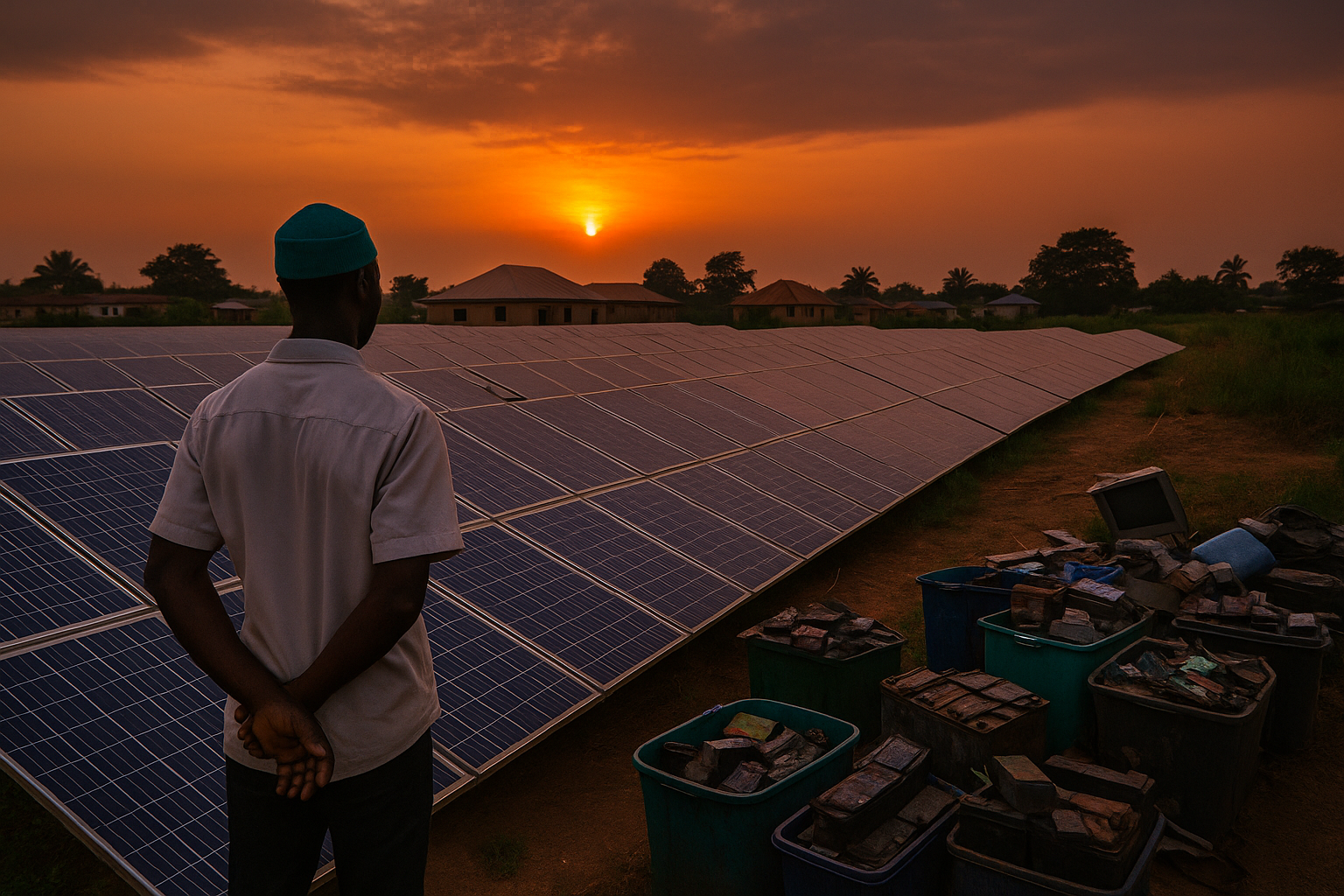
African imports of solar panels from China rose 60 percent in the twelve months to June 2025, reaching 15,032 megawatts. Twenty African countries set individual import records over that period. Chinese solar exports to Africa surged a further 83 percent year-on-year in April 2026 alone. This isn't primarily planned renewable deployment through government procurement programmes, but households and businesses buying their way out of diesel price volatility and unreliable grid supply, as quickly as the logistics allow. The savings from avoiding diesel can repay the cost of a solar panel within six months in Nigeria. That economic logic is producing a self-reinforcing demand surge that policy didn't plan and cannot now stop.
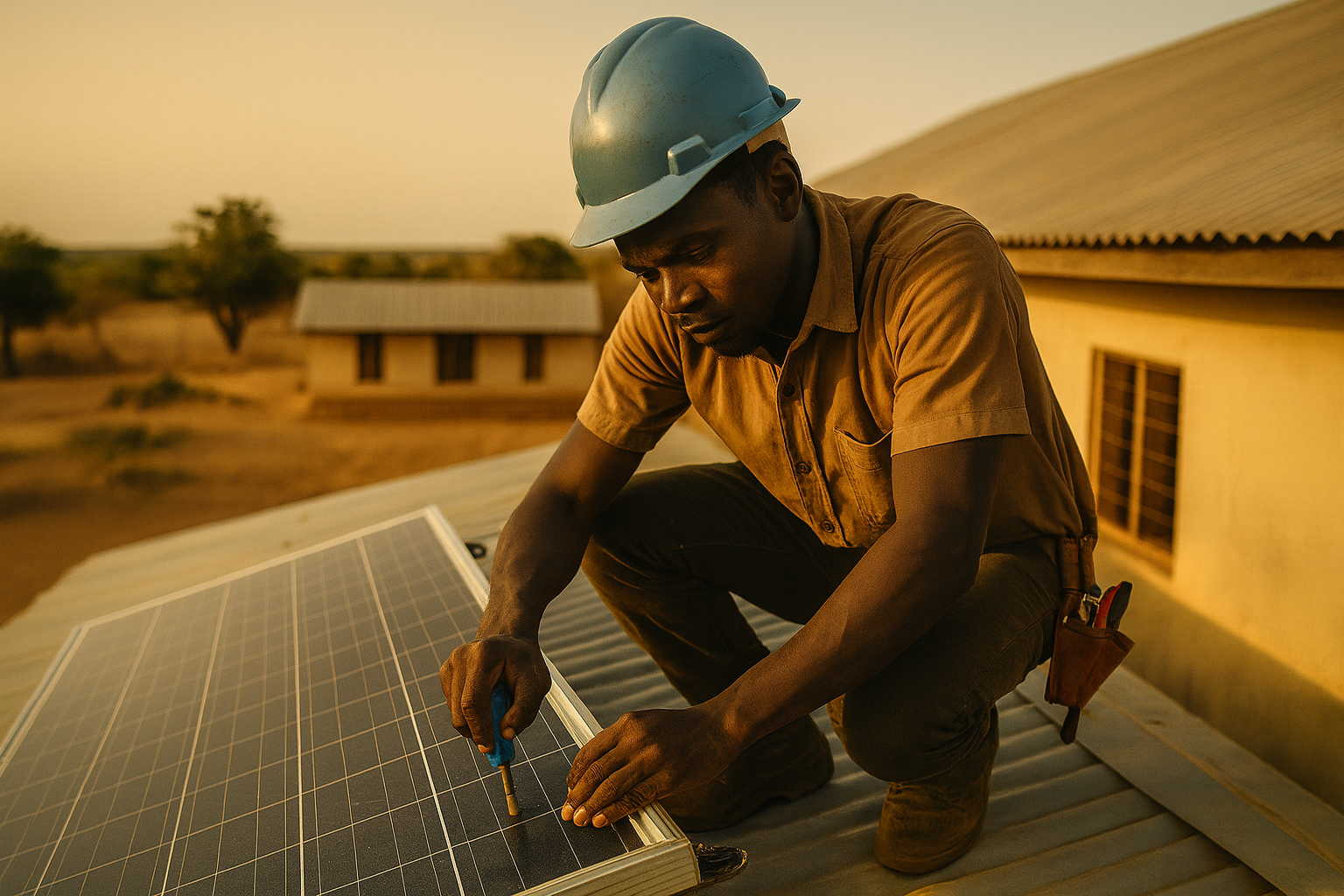
That surge is, by itself, a workforce opportunity of substantial scale. Someone has to install, certify, maintain, and eventually replace all of that hardware, at scale, across markets ranging from dense urban environments to remote rural settlements, for years and then decades. Whether that activity becomes a formal local industry generating skilled, certified, reasonably compensated jobs, or whether it remains what it currently largely is, an undocumented solar economy of uninspected, unmaintained, and uncertified installations, depends entirely on decisions being made right now about standards, certification requirements, and the local training capacity to enforce them.
So far, the market has been moving significantly faster than the workforce infrastructure built to serve it. That is a systems failure, a failure to build the scaffolding of certifications, training programmes, inspection regimes, and local supply chains that turns an import surge into an industry.
The scale of what is actually on the table
The FSD Africa and Shortlist modelling projects up to 3.3 million direct green jobs across Africa by 2030, with renewable energy accounting for up to 2 million of those roles and solar alone accounting for 1.7 million. South Africa's solar sector is projected to generate 140,000 of them, and Kenya's, 111,000. These are demand-side forecasts based on sector growth already visible in the import and deployment data.
Set against a current continental renewable workforce of roughly 324,000, Africa needs to approximately ten times the size of its trained energy workforce in the next four years. The African Development Bank projects the continent's youth population will reach 850 million by 2050, which it calls a demographic dividend, but one whose value depends entirely on investments made in that population now. Without adequate training pathways, 850 million young people are not a dividend, but pressure.
I have been in communities across Africa where young people are desperate for exactly the structured, skilled pathway the energy transition could provide, where solar panels are visible on rooftops and generator fuel costs eat into household budgets daily, and where nobody has built the training infrastructure that would connect the people looking for work to the industry looking for workers. That gap is not a question of ambition, but one of systems design.
The solar panels are arriving at scale. The workers who would install them correctly, certify them, maintain and integrate them into functioning electricity systems aren't being produced at anywhere near the pace the import data implies. The window for doing something about it before the next million panels arrive is shorter than the conversation suggests.