Does Africa Have a Green Industrial Policy or Just Plans Without Industry?
In the past decade, industrial policy has returned to the centre of global economic strategy. But unlike earlier eras defined by steel mills and automobile factories, the new wave of industrial policy is built around decarbonisation, electrification and technological supply chains.
The United States’ Inflation Reduction Act, Europe’s Green Deal Industrial Plan and China’s long-standing state-led manufacturing strategy all share a common feature: they combine climate goals with industrial competitiveness. These governments are no longer treating the energy transition solely as an environmental challenge, but as a race to build the industries that will power the next global economy.
Green industrial policy is about building domestic capability in strategic sectors such as batteries, electric vehicles, renewable manufacturing, hydrogen production and low-carbon materials.
The stakes are significant. According to the International Energy Agency, electricity demand is growing faster than overall energy demand globally, driven by electrification of transport, cooling, data infrastructure and industrial processes.
This transformation is reshaping global value chains, and countries that position themselves early in clean-energy industries stand to capture manufacturing jobs, export markets and technological leadership.
For Africa, the implications are profound. The continent possesses vast renewable resources and a significant share of the world’s critical minerals required for electrification technologies. Yet the key policy question remains unresolved: Does Africa have a coherent strategy to convert these advantages into industrial capability?
Africa’s ambitions: from extraction to industrialisation
In recent years, African policymakers have increasingly emphasised the need to move beyond resource extraction toward industrial value creation. This shift is most evident in discussions of critical minerals such as cobalt, lithium, manganese, graphite, and copper, which are essential inputs for batteries and renewable technologies.
Recognising this opportunity, the African Union adopted the Africa Green Minerals Strategy (AGMS), which explicitly frames critical minerals as a foundation for green industrialisation rather than simply export commodities.
The strategy calls for greater local processing, regional value chains and stronger governance of mineral resources. Its underlying argument is straightforward: if Africa remains merely a supplier of raw materials for the global energy transition, it will miss the opportunity to capture higher-value industrial activity.
Parallel initiatives reinforce this ambition. The African Green Industrialisation Initiative (AGII), launched with support from development finance institutions and international partners, aims to mobilise large-scale investment in renewable-powered industrial projects across the continent.
These frameworks signal a clear shift in narrative: Africa is no longer positioned solely as a site for renewable deployment or climate mitigation. It increasingly seeks to become a manufacturing and processing hub within the global green economy.
Yet ambition and execution are not the same thing. The question is whether these strategies constitute a functioning industrial policy or remain aspirational frameworks.
The country reality: islands of strategy rather than a continent-wide system
In practice, green industrial policy in Africa currently exists less as a continent-wide system and more as a series of national experiments.
South Africa provides one of the clearest examples. The country has begun aligning industrial policy with the global shift toward electric mobility, introducing incentives designed to support domestic production of electric vehicles and associated supply chains.
The policy recognises that South Africa’s automotive industry, one of the continent’s largest manufacturing sectors, risks losing export markets if it fails to adapt to global EV transitions.
Morocco has pursued a different path, leveraging its proximity to European markets to position itself as a potential hub for green hydrogen and low-carbon industrial production. International partnerships and feasibility studies increasingly frame hydrogen not only as an energy export but as a platform for domestic industrial development.
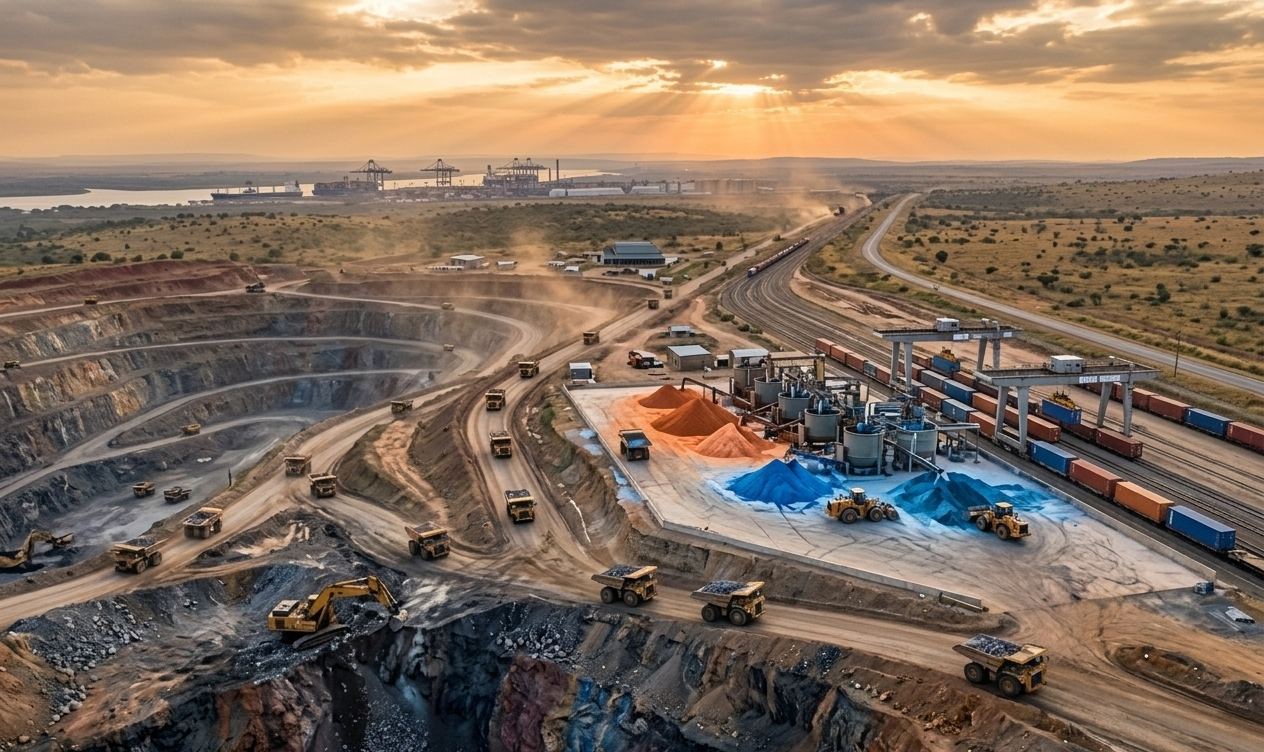
Elsewhere, mineral-rich countries such as Namibia, Zambia and the Democratic Republic of Congo are exploring strategies for mineral beneficiation and battery precursor manufacturing.
These initiatives demonstrate that elements of green industrial policy are emerging across Africa, but remain uneven and fragmented. No continent-wide system yet coordinates infrastructure planning, trade rules, financing frameworks and industrial clusters in the way seen in more advanced industrial economies.
The execution gap: infrastructure, finance and institutional capacity
The biggest constraint on Africa’s green industrial ambitions is not a lack of strategy, but the gap between strategy and execution.
Industrial policy succeeds when multiple systems align simultaneously: infrastructure, finance, regulatory certainty and workforce capability. In Africa, these components often evolve at different speeds.
Electricity infrastructure is one of the most critical constraints. Green industries, whether battery production, mineral processing or hydrogen electrolysis, require large volumes of reliable electricity. Yet power reliability remains uneven across many African economies.
The World Bank notes that electricity reliability and utility governance remain significant barriers to economic productivity across the region.
Similarly, the African Development Bank emphasises that infrastructure gaps, particularly in energy and logistics, continue to constrain industrial competitiveness.
Financing also remains a structural challenge. Green industrial projects often require large upfront capital investments and long development timelines. In many African markets, high interest rates and currency volatility increase financing costs relative to competing regions.
Without affordable capital and reliable infrastructure, industrial policy risks remaining rhetorical rather than operational.
Trade integration and the AfCFTA question
Another critical component of industrial policy is market size. Manufacturing industries require large and predictable markets to achieve economies of scale.
Africa’s answer to this challenge lies in the African Continental Free Trade Area (AfCFTA), which aims to create a single market spanning more than fifty countries. In theory, AfCFTA could enable regional value chains in sectors such as batteries, renewable components and green manufacturing.
But implementation remains uneven. Cross-border logistics constraints, regulatory fragmentation and limited industrial coordination continue to restrict intra-African trade. Even basic mobility issues, such as visa restrictions and inconsistent customs procedures, illustrate the gap between integration ambition and practical reality.
Green industrial policy requires not only national strategies but also regional coordination. Battery supply chains, for example, may involve lithium extraction in one country, processing in another and manufacturing in a third.
The deeper question: can Africa turn resources into capability?
Africa’s role in the global energy transition is frequently framed around resource abundance. The continent holds substantial reserves of minerals essential to electrification technologies and possesses some of the world’s strongest renewable energy potential.
But resources alone don't create industrial competitiveness. History offers many examples of resource-rich regions that remained peripheral to manufacturing value chains.
What distinguishes successful industrial strategies is the ability to transform natural endowments into technological and institutional capability. Green industrial policy is fundamentally about capability building.
It requires investments in education, research institutions, technical training and regulatory competence. Engineers, economists and policymakers must develop expertise in emerging technologies and complex energy systems.
Without this institutional depth, even well-funded infrastructure projects struggle to deliver sustained industrial development. So the challenge extends beyond energy policy, and touches education systems, financial markets, trade frameworks and governance institutions.
Green industrialisation is an ecosystem, and not a single policy.
Why this matters for Africa’s economic future
The stakes for Africa are substantial. If green industrial policy succeeds, the continent could capture a larger share of the value generated by the global energy transition. Processing critical minerals domestically, manufacturing renewable components and exporting low-carbon industrial products could create jobs, strengthen fiscal revenues and accelerate economic diversification.
If it fails, Africa risks remaining primarily a supplier of raw materials to industrial economies elsewhere. The difference between these two outcomes will depend on the institutional capacity to implement complex industrial strategies.
The global race for clean industries is accelerating. Governments in North America, Europe and Asia are deploying large financial incentives and strategic policy tools to secure leadership in emerging sectors.
For Africa, the window of opportunity is real but time-limited. Industrial capabilities take years to develop, and supply chains become entrenched once established.
Whether Africa emerges as a major industrial player in the green economy or remains on the periphery will depend on the decisions made during this decade.
Conclusion: strategy exists, but systems must follow
So does Africa have a green industrial policy? The answer is nuanced.
The continent now has strategies, frameworks and ambitions that clearly recognise the importance of green industrialisation. Initiatives such as the Africa Green Minerals Strategy and national policy experiments demonstrate growing awareness of the economic opportunities created by the energy transition.
But strategy alone doesn't constitute industrial policy. Industrial policy becomes real when infrastructure, financing, trade integration and institutional capacity align to support sustained industrial activity.
In Africa, those systems are still developing. The coming decade will determine whether the continent’s green industrial ambitions evolve into a coherent strategy capable of shaping global supply chains or remain a collection of promising but fragmented initiatives.
The question, ultimately, is not whether Africa understands the opportunity, but whether the institutions required to seize it can be built quickly enough.