Congo Has the Minerals the World Needs. The Question Is Whether It Can Control Them
There is a moment, often missed in the headlines, when a country stops being a supplier and becomes a negotiator of power. The Democratic Republic of the Congo (DRC) appears to be entering that moment.
In late March, as global attention remained fixed on supply chains and decarbonisation targets, Kinshasa deepened its mining partnership with China, expanding cooperation on geological data, investment protections, and, crucially, local processing. Almost simultaneously, it continued conversations with the United States around a rival critical minerals framework, one tied to investment, security and geopolitical alignment.
Taken together, these moves are strategic. They signal a country attempting something far more complex than choosing sides. The DRC is trying to rewrite the terms of engagement in a global energy transition that increasingly depends on its soil.
But beneath this assertiveness lies a question that has haunted resource-rich economies for decades: Can Congo convert geopolitical attention into structural transformation, or will it once again sit at the base of a value chain it doesn't control?
Why Congo is now at the centre of the global minerals race
To understand what is at stake, it is necessary to step back from the immediacy of deals and diplomacy and consider the scale of DRC's position.
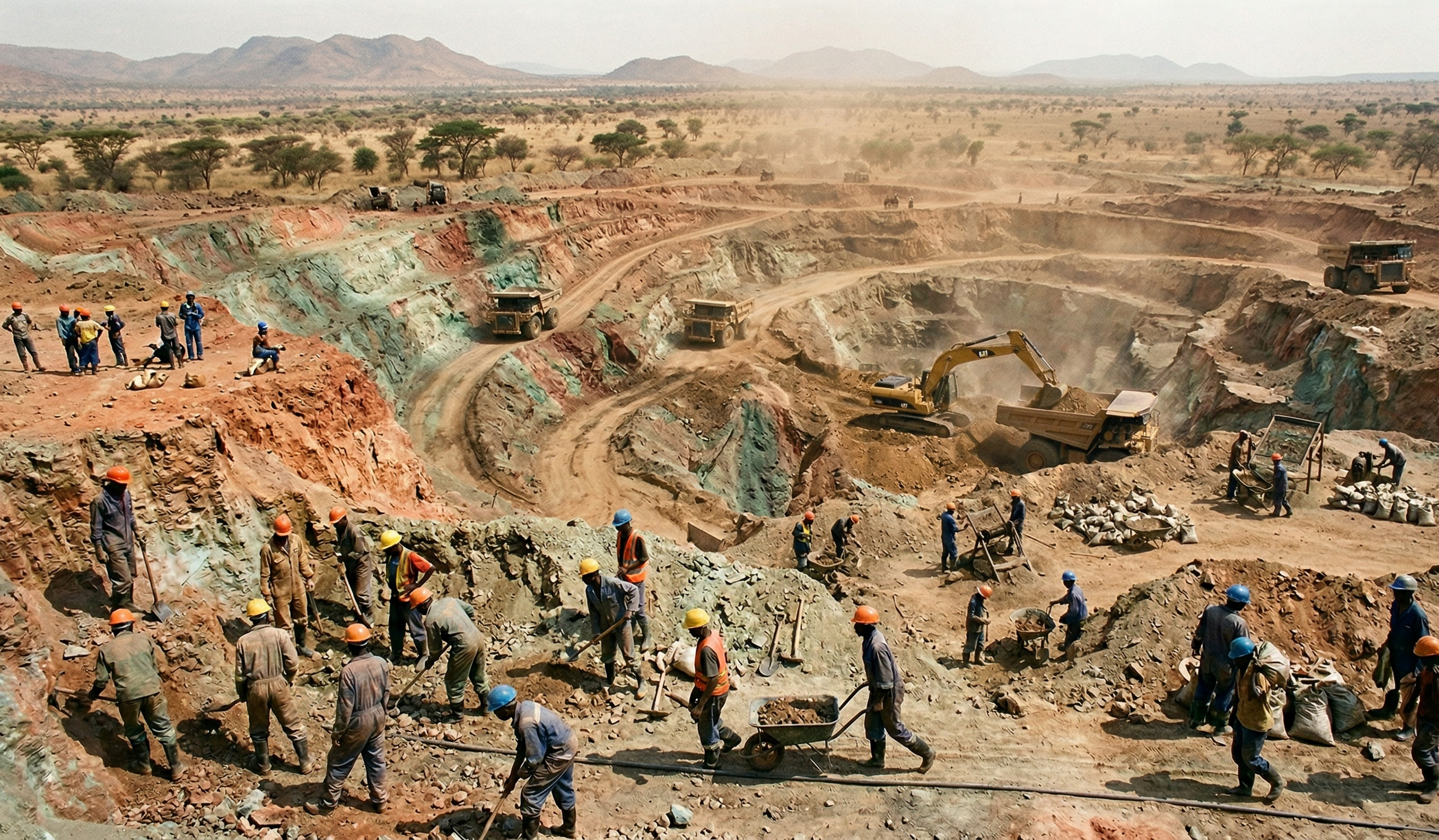
The country produces the majority of the world's cobalt, a mineral indispensable to the lithium-ion batteries that power electric vehicles and energy storage systems. Under its terrain lies not only cobalt, but copper, lithium, and coltan, materials that collectively underpin the architecture of the clean energy economy.
In another era, such abundance might have been a geological curiosity. Today, it is geopolitical gravity. The energy transition, so often described in terms of technology, is, at its core, a resource transformation. That transformation runs through places like Kolwezi and Lubumbashi far more than it does through boardrooms in Washington or Brussels.
What is different now isn't merely demand, but urgency. Governments are no longer simply sourcing minerals; they are seeking to secure them, de-risk them, and, where possible, control the systems through which they move. Congo sits at the centre of that urgency.
China's structural grip versus America's late strategic bid
For more than a decade, China has approached DRC not as a strategic anchor. Through a combination of state-backed financing, infrastructure-for-minerals agreements, and aggressive acquisition of mining assets, Chinese firms have embedded themselves deeply in the Congolese extractive sector. They do not merely extract minerals; they shape the ecosystem around them, from logistics to processing. This is why China's position isn't easily displaced.
The United States, by contrast, arrives with a different proposition and a different set of constraints. Its strategy is framed around diversification and resilience: reducing reliance on Chinese-controlled supply chains whilst encouraging private-sector investment into African minerals.
But where China offers speed and scale, the US. offers frameworks and conditions. Its companies are more cautious, its financing less centralised, its tolerance for political and security risk considerably more limited.
This divergence is visible in the ground realities of Congo, where many of the most resource-rich areas are also the most unstable. The asymmetry that results is significant. China can move faster. But the United States offers something China cannot: an alternative system, and with it, an alternative set of political relationships. DRC, for now, is choosing to engage both.
How Kinshasa is turning competing powers into negotiating leverage
From the outside, Congo's approach may appear fragmented, signing agreements with China whilst entertaining American-backed partnerships, but in practice, it reflects a deliberate posture.
This is hedging not as uncertainty, but as leverage. By maintaining multiple partnerships, DRC increases its negotiating space. It can extract concessions, diversify risk, and avoid overdependence on any single external actor, playing competing interests against one another to secure better terms.
But hedging is only as effective as the system that manages it. Without strong institutional capacity, what appears as strategic diversification can quickly become fragmented governance: multiple deals, overlapping commitments, and limited control over outcomes. This is where the story becomes less about geopolitics and more about statecraft.
Local processing: the promise that infrastructure must keep
Among the most notable features of DRC's recent agreements is the renewed emphasis on local processing.
For decades, African mineral economies have exported raw materials only to import finished products at significantly higher value. The case for processing minerals domestically, refining cobalt, and producing battery precursors has long been framed as the pathway to industrialisation. The new China deal gestures in this direction.
But gestures are not systems. Local processing requires more than contractual clauses. It demands reliable and affordable electricity, skilled technical labour, transport and logistics infrastructure, stable regulatory environments, and sustained long-term industrial policy.
Congo struggles with many of these fundamentals; power supply remains inconsistent, industrial ecosystems are underdeveloped, and financing for downstream industries is limited.
Without addressing these constraints, local processing risks becoming an aspirational layer added on to an extractive core. The danger is subtle but significant: value addition becomes a narrative rather than a transformation.
Why Eastern DRC's instability is now a global supply chain problem
Complicating this landscape further is the question of security. Eastern Congo remains volatile, with armed groups controlling or influencing access to key mineral zones. This instability is not incidental; it is deeply intertwined with the economics of extraction.
For the United States, this creates both a challenge and an entry point. Efforts to secure mineral supply chains are tied to efforts to stabilise the region, linking investment to broader security cooperation and diplomatic alignment.
This introduces a new dimension to mineral diplomacy. Resources are no longer negotiated solely through economic frameworks but are embedded within security architectures and geopolitical strategies. For Congo, this raises the stakes considerably, because engaging in mineral partnerships now involves navigating not just markets, but systems of power.
The variable that will determine DRC's trajectory
Amid the visible contest between China and the United States, institutional capacity will likely determine the outcome.
Congo's ability to shape its own trajectory depends less on which partner it chooses and more on how effectively it governs those partnerships. Can it enforce contracts? Can it manage revenues transparently? Can it coordinate infrastructure development? Can it build state-owned entities capable of meaningful strategic influence?
These aren't abstract questions, but are the difference between extraction and transformation. History offers a cautionary note. Resource wealth, in the absence of strong institutions, has rarely translated into broad-based development, but has, more often, entrenched dependency. The energy transition doesn't automatically change that pattern. It simply raises the stakes.
Africa's larger question: supplier of materials or producer of value?
What is unfolding in the Democratic Republic of Congo isn't unique. It is a concentrated version of a broader African dilemma.
Throughout the continent, countries rich in lithium, cobalt, nickel, and rare earth elements are being drawn into the same global dynamics, courted by competing powers, promised investment, and positioned as critical nodes in the energy transition.
Conclusion: indispensable supplier to value chain architect
It is tempting to view Congo's recent deals through the lens of great-power competition, China versus the United States, influence versus counter-influence. But this framing is incomplete.
What is really at stake isn't which partner Congo chooses, but whether it can redefine the structure within which those partnerships operate. Minerals confer leverage. But leverage, without strategy and institutional capacity, dissipates.
Congo has already secured the world's attention. It has positioned itself as indispensable to the energy transition. The harder task lies ahead: to move from being central to the supply chain to shaping it.
Because in the end, the energy transition will not be defined only by where minerals are found. It will be defined by who controls the value they create.