Zambia’s Energy Future Depends More on Mines Than Megawatts
By Chisha Chisha and Precious Mwansa-Chisha|
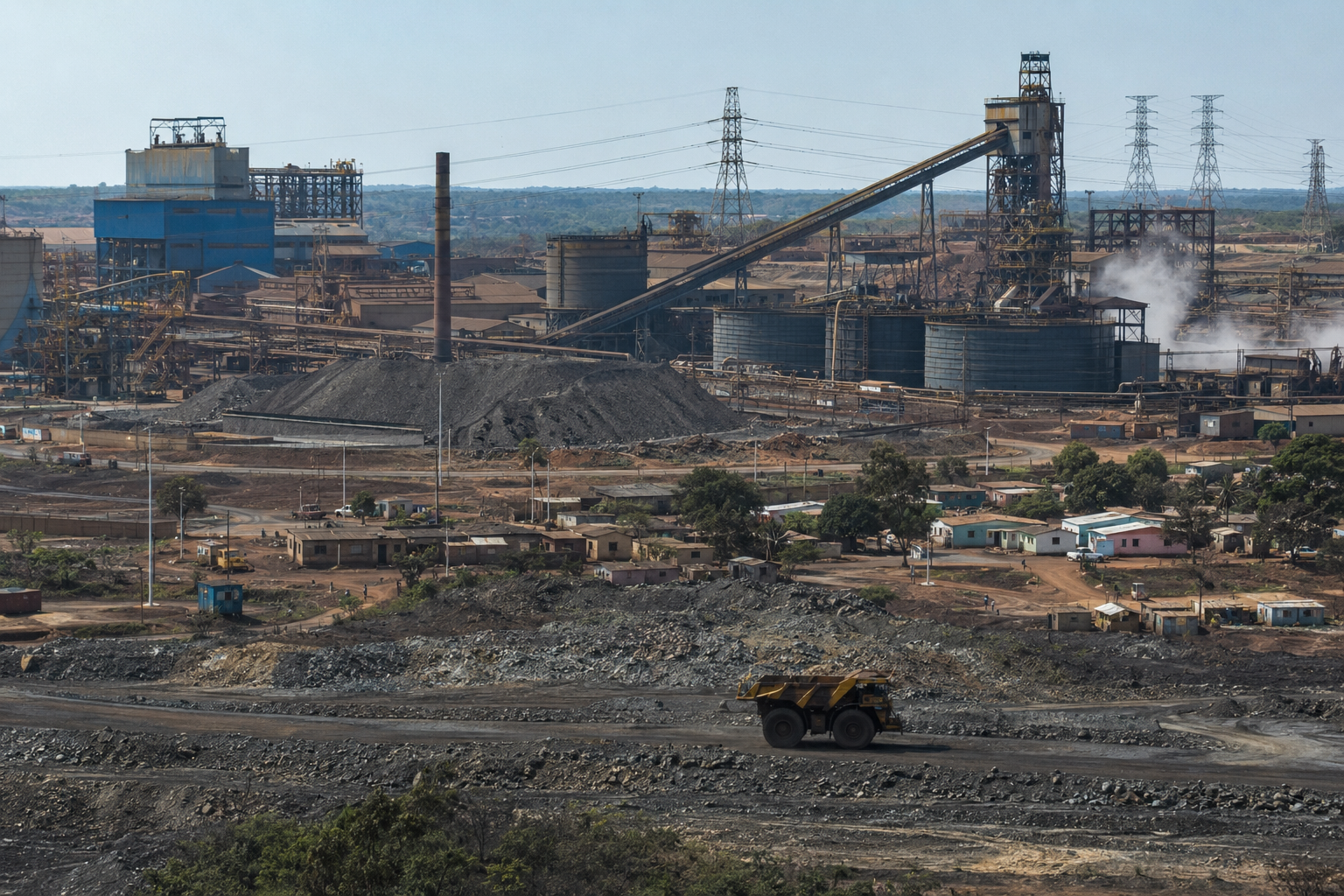
Zambia is most often discussed in energy debates through the lens of hydropower, load shedding and grid expansion. These are legitimate concerns, but they frame the wrong question. The decisions that will most significantly shape Zambia's long-term energy security are increasingly being made, not in the power sector, but in the mining sector, in choices about how copper, cobalt and manganese are extracted, processed, priced and exported. These minerals are not merely export commodities; they are core physical inputs into renewable generation equipment, transmission networks, electric vehicles and battery storage, the same technologies that define the global energy transition. They are also the demand anchors that determine whether power infrastructure in mineral-rich frontier markets is built and financed at all.
Zambia's critical minerals therefore sit on both sides of the energy equation: as upstream inputs into the clean energy systems the world is building, and as the investment stimulus that drives the power sector development Zambia needs. Whether Zambia benefits from this dual position, or simply subsidises it, will be determined largely by how it governs these resources.
Copper as Energy Infrastructure
Zambia is Africa's second-largest copper producer, with Copperbelt ore grades averaging roughly 2.5% copper against a global average of 0.5-0.7%. Mining contributes approximately 12-14% of GDP, over 75% of export earnings and around 50% of national electricity consumption (World Bank, 2025). The International Energy Agency (IEA) projects that copper demand in clean energy applications alone will rise by over 50% by 2040, driven by wind turbines, solar systems, electric vehicle (EV) charging infrastructure and high-voltage transmission lines. Together, Zambia and the Democratic Republic of Congo (DRC) hold an estimated 70% of the minerals needed for battery and EV production globally (World Economic Forum, 2026), and Africa's first cobalt sulphate refinery, a key battery precursor facility, is expected online by late 2025 (British Geological Survey, 2025).
The implication is direct: the copper Zambia mines today are the physical substrate of the energy systems the world is building. Copper wire, transformer windings, EV motor components and grid-scale battery casings are all downstream of the ore body. Yet, Zambia currently exports the majority of its copper as concentrate or cathode, capturing the lowest segment of that value chain, while the surplus is realised by smelters, manufacturers and technology deployers in China, Europe and North America (IEA, 2025). The government's three-million-tonne copper strategy for 2031 is ambitious and well-founded in market terms (World Bank, 2025). However, production volume alone does not resolve the structural question of who captures the value, or whether Zambia can use its mineral position to build energy security.
The Governance Gap: Minerals and Energy as Separate Domains
Mineral policy in Zambia is treated primarily as a fiscal and investment issue, administered through the Mines and Minerals Development Act with objectives oriented toward production growth, foreign investment and revenue generation. On the other hand, energy policy sits in a separate ministry, focused on generation capacity, tariff regulation and electrification targets and climate strategy occupies a third institutional space. The result is that decisions about mining licences, export agreements and beneficiation incentives are rarely assessed for their energy system implications, and energy planning does not fully account for the demands or opportunities that mineral development creates.
Zambia's Integrated Resource Plan 2023 (IRP 2023), the principal national planning instrument for the power sector, centred its mining demand projections on copper and the established large mines. Emerging critical minerals, including manganese, nickel, graphite and battery-grade cobalt processing, were not systematically incorporated, leaving a material gap between the mineral sector's stated ambitions and the demand assumptions underpinning power system expansion.
A new mining licence, for example, may be evaluated on employment and royalty contribution without any structured consideration of the power demand it places on an already constrained grid, or the opportunity cost of exporting unprocessed ore rather than developing a downstream manufacturing base, cable production, transformer components or battery precursor refining that would anchor a domestic industrial energy economy.
Zambia's installed generation capacity reached approximately 3,986MW by mid-2025, of which 85% is hydropower (U.S. Department of Commerce, 2026). That structural dependence was exposed twice in the past decade by drought-induced load shedding crises, most severely during the 2023-2024 El Niño drought when Lake Kariba's volume fell to below 3% of normal capacity, forcing outages of up to 21 hours per day and prompting ZESCO Limited (ZESCO) to request mining companies curtail demand by up to 40% of normal consumption. The power system's fragility and the mineral sector's governance are not unrelated problems. They are the same problem, approached from different ministries.
The Golden Thread: Minerals as the Anchor for Power Infrastructure Investment
Mining demand does not just pin itself to power infrastructure; it makes power infrastructure financially viable. Power projects in frontier markets face a fundamental bankability problem: lenders require contracted revenue before committing debt, developers cannot sign long-term PPAs until offtakers are committed, and offtakers cannot commit until infrastructure exists to serve them. Brozynski and Leibowicz (2022) formalise this as the infrastructure chicken-and-egg problem, in which investment stalls because neither side will move first.
As open access reforms displace the single-buyer model, under which the national utility provided the bankability anchor backed by sovereign guarantees, mining companies fill that gap both directly and indirectly. Their long asset lives, dollar-denominated revenues and investment-grade sponsors make their willingness to sign long-term PPAs a primary determinant of whether a generation or transmission project reaches financial close.
Since roughly 70% of a generation project's cost derives from debt financing, offtaker creditworthiness directly sets borrowing costs and therefore the ultimate price of electricity. A mine committing to a 20-year PPA transforms a speculative project into a bankable one. Under a liberalised market structure, critical minerals demand is not merely a consequence of energy infrastructure decisions; in frontier markets, it is frequently a precondition for making those decisions investable.
Cross-Border Infrastructure: The Pattern in Practice
The clearest evidence is in the cross-border transmission projects now advancing across the region. The Kalumbila-Kolwezi Interconnector Project (KKIP), a 330kV line linking Zambia's North-Western Province to the DRC's Lualaba Province, was approved in May 2025 and is estimated at $250m-270m. The existing Luano-Kasumbalesa 220kV interconnection, co-owned by Copperbelt Energy Corporation (CEC) and DRC state utility SNEL, is simultaneously being upgraded from 250MW to 550MW. The Zambia-Tanzania-Kenya (ZTK) corridor, launched in April 2025 at $292m with World Bank, EU and UK co-financing, extends the same logic northward. These projects didn't happen despite mining demand; they happened because power supply is chasing critical minerals demand in Zambia and the southern DRC.
Sovereignty, Climate Justice and What Needs to Change
The stakes of getting this governance architecture wrong are not only economic, but they are also environmental and social. Zambia bears the cost of land degradation, water contamination and community displacement, while value is captured downstream by manufacturers and technology deployers in China, Europe and North America. Critical mineral refining market concentration has deepened, not eased: the average market share of the top three refining nations rose to 86% in 2024 (IEA, 2025). Zambia supplies the raw material for other countries' energy transitions while remaining dependent on expensive, imported clean technology. This is the climate justice dimension of the governance gap, and it will not be corrected by production targets alone.
What is required is an integrated policy framework that treats critical minerals explicitly as strategic energy assets, subject to coordinated planning across mining, energy and industrial policy. This means embedding energy system considerations into mining licence conditions; developing beneficiation strategies linked to energy industrialisation targets; and ensuring that power sector planning accounts for both the demand profile and the bankability anchors that mining investment provides. Zambia has taken early steps through open access reforms, IPP frameworks and a National Critical Minerals Strategy published in 2024 (U.S. Department of Commerce, 2026). However, their value depends entirely on whether they reach across ministry boundaries and connect mineral governance to energy strategy in a structured rather than incidental way. Internationally, mineral partnership agreements with the EU and United States offer potential platforms, but only if they move beyond investment facilitation toward genuine structural transformation (World Economic Forum, 2026).
Conclusion
Zambia's energy debate needs to expand beyond megawatts and generation targets. Equally, its critical minerals strategy needs to expand beyond tonnage. Critical minerals are not peripheral to Zambia's energy future; they are its physical foundation. They are the inputs into the core renewable energy equipment the world is building at scale and, at the same time, their extractive operations are the commercial anchors that increasingly determine whether new power infrastructure in frontier markets gets financed at all. Treating mineral policy as a fiscal matter, disconnected from energy planning and climate strategy, is both a governance gap and a commercial mistake. Reframing critical minerals as energy infrastructure, not extractive assets, is not a rhetorical move. It is the correct analytical starting point for any serious conversation about Zambia's energy future.