Liberia Power Outages: Why Lights Fail When the Dam Spills
Policy analysis: Mount Coffee spilled water while Liberia lost power. A survey and utility data show why. Download the ETA analysis.
Executive Summary
Liberia has expanded generation substantially over the past decade, yet customers of the Liberia Electricity Corporation continue to experience frequent interruptions, slow fault resolution and visibly deteriorating network assets. This analysis tests five competing explanations: generation adequacy, network capacity, operations and maintenance, utility finances and institutional capability. An original customer survey and LEC's July and August 2026 performance data point to the same place. In August, the Mount Coffee hydropower plant was spilling water at 99.48 percent availability, yet distribution reliability still missed target, while 66 kV lines and transformers held full availability. The constraint lies in the distribution network's capacity to execute repairs, limited by materials, spare parts, transformer-repair throughput and fleet. The analysis concludes that new generation will not deliver commensurate gains in reliability unless distribution O&M capability grows alongside it, and recommends a distribution asset-management and maintenance-execution programme within LEC, paired with a predictable O&M budget line.
Key Findings
73.4 percent of surveyed customers waited more than 24 hours for a fault response, or got none. 75.0 percent of surveyed customers had observed deteriorated poles, conductors or transformers. In August 2026, Mount Coffee ran at 99.48 percent availability and spilled water, yet distribution SAIDI was 15.49 hours against a target of 10. Transmission held: 66 kV lines and power transformers were fully available, while 614 outage events were logged on the 22 kV network. LEC's records show preventive maintenance at substations, but repair work on distribution assets constrained by materials, spares, transformer-repair throughput and fleet. Peak demand has grown roughly 4.5-fold since 2017, adding pressure on the distribution network. Whether these constraints originate in how O&M is financed, including donor-funded assets handed over without maintenance provision, remains a hypothesis to test.
In August 2026, the dam at Mount Coffee had more water than it could use. The hydropower plant that supplies most of Liberia's grid electricity ran at 99.48 percent availability and was spilling water. In the same month, customers of the Liberia Electricity Corporation (LEC) kept losing power. Distribution reliability, measured without deliberate load shedding, missed its target: the average customer was without supply for 15.49 hours against a goal of 10.
So what failed? ETA Fellow Kemoh Lumei's Signature Analysis sets out to answer that question, and the answer carries a warning for every capital that is planning new power plants.
Four numbers from one month
73.4 percent. The share of surveyed LEC customers who waited more than 24 hours for a response after reporting a fault, or never got one.
75.0 percent. The share who had seen poles, conductors or transformers deteriorating.
614. The outage events logged on the 22 kV distribution network in August, while the 66 kV lines and power transformers stayed fully available.
3 to 10. The number of repaired transformers waiting for dispatch, up from three in July to ten in August.
Five suspects, one place the evidence points
The analysis tests five explanations for Liberia's unreliable power: too little generation, too little network capacity, weak operations and maintenance, strained utility finances and thin institutional capability. It rests on two kinds of evidence. The first is an original survey of 64 LEC customers, which the paper itself says is not statistically representative. The second is LEC's operating data for July and August 2026, gathered through interviews with the utility's operations and maintenance team.
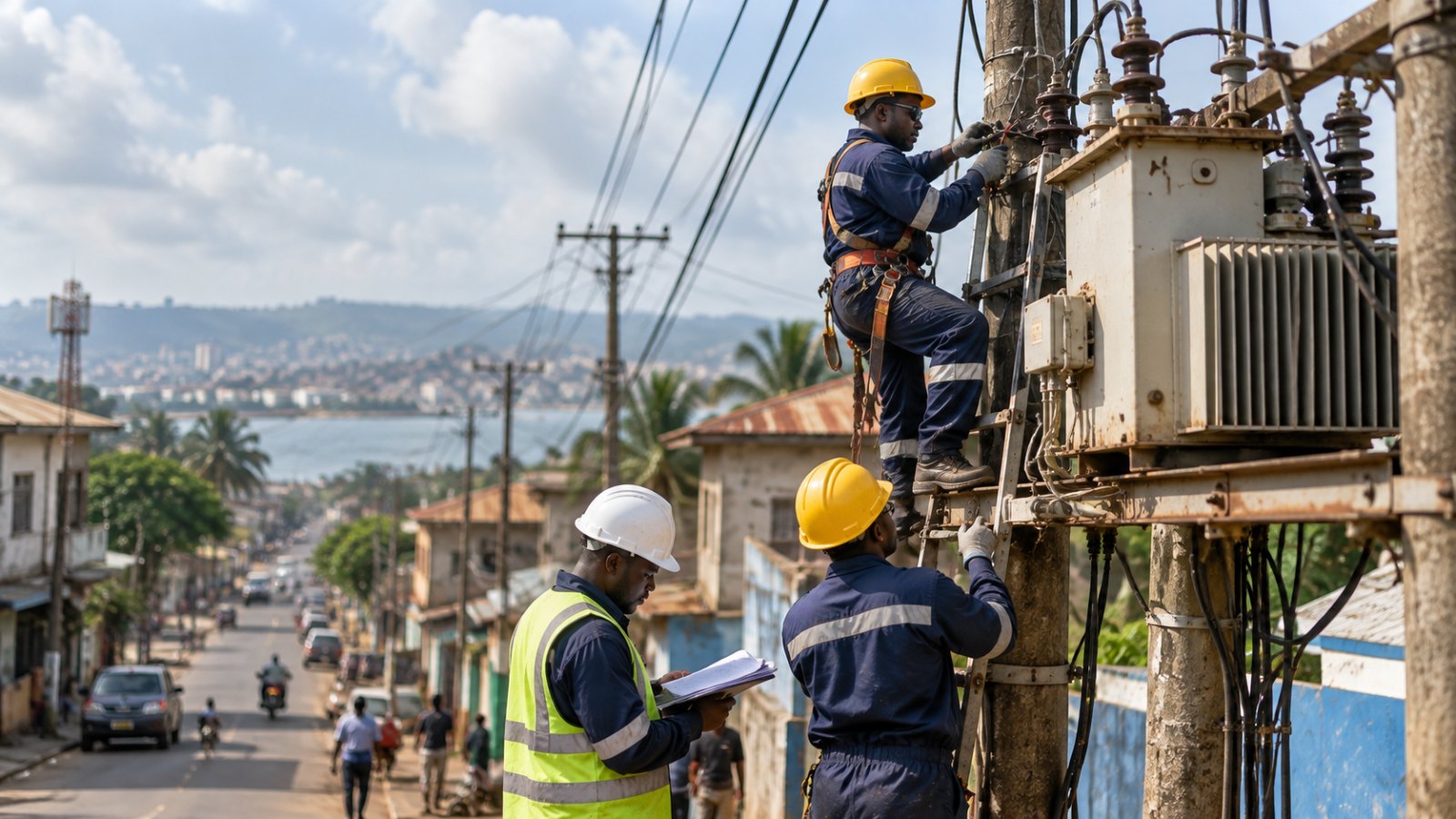
Together they point to the 22 kV network. LEC's substation team was meeting its scheduled maintenance tasks. What the distribution function lacked was the capacity to carry out repairs: materials, spare parts, transformer-repair throughput and vehicles were all constraints, while peak demand has grown roughly 4.5-fold since 2017. The load keeps rising too. LEC nearly doubled its customer base, from 142,947 in 2021 to 282,505 in 2023, and every new connection is another asset to maintain.
A fair question: what about the dry season?
August is a clean test because the dam was full. The dry season is a different test. From January to May, Mount Coffee's capacity falls by more than 75 percent, and Liberia leans on imports through the CLSG interconnector, of which only half of the 27 MW it receives was available when the national energy compact was written. Shortages of supply are real.
The conclusion is narrower than it first sounds. New generation will not deliver commensurate gains for customers unless the capability to operate and maintain the distribution network grows alongside it. In the wet season the missing piece shows up with water to spare. In the dry season both gaps bind at once, and fixing supply alone would leave the second untouched. The World Bank's reading of LEC points the same way, pairing investment in supply with reforms to utility performance.
What the analysis refuses to claim
The paper is careful about its limits. It does not assert that maintenance is the sector's only binding constraint. It treats two popular explanations as hypotheses, not facts: that maintenance is starved of money because of revenue stress, and that donor-financed assets are handed over without provision for their upkeep. A colour-coded map of the utility's break-fix cycle marks which links in the chain are demonstrated, which are supported and which still need evidence. That candour makes the findings easier to trust and easier to test.
What LEC could do now
The principal recommendation is a distribution asset-management and maintenance-execution programme inside LEC. In practice, that means an asset register and criticality ranking for distribution transformers and 22 kV feeders, starting in Paynesville and Gardnersville; scheduled and condition-based maintenance extended from substations to distribution assets; minimum stocks of transformer oil, fuses, arresters and jumpers; and vehicles allocated to the maintenance plan.
A protected, predictable operations and maintenance budget line for transmission and distribution, reported against actual spending each quarter, would give the programme resources it can plan around. The regulator would add customer-level fault-resolution times and repeat-fault rates to reliability reporting. Reforms to how donors finance the lifecycle of the assets they fund wait until the evidence says whether they are the right remedy.
Why it reaches beyond Monrovia
Liberia's Mission 300 energy compact aims to connect 100,000 households a year, lift access to 75 percent by 2030 and expand generation by 150 percent. Every added connection and every added megawatt becomes an asset that someone must maintain. ETA's Colloquium recap recorded Lumei's findings alongside a theme from the whole day: what happens after installation decides whether investment becomes development. ETA has also traced why grid readiness decides whether new generation delivers and why training systems produce the wrong mix of workers for the grid.
Three questions follow for any utility, in any country. How long does a reported fault wait? How many repairs stand idle for want of materials, spares or vehicles? And who answers for the backlog? The full analysis shows how one utility's answers can be measured.
Download the full Signature Analysis below. It includes the customer survey results, the evidence status of each link in the break-fix cycle and the full recommendation hierarchy.
Suggested Citation
Lumei, K. (2026). An Assessment of Operations and Maintenance Bottlenecks in Transmission & Distribution (T&D) Electrical Networks: Case Study, Liberia Electricity Sector. ETA Fellows Programme Signature Analysis. Energy Transition Africa.