ETA Colloquium 2026 Recap: Three Takeaways for Africa
Transition or Transformation? What Will the New Energy Economy Mean for Africa's Development?
Africa's energy transition is gathering pace. New electricity infrastructure is being developed, renewable technologies are entering homes and businesses, and the continent's critical minerals are attracting global investment.
But will these developments create the industries, jobs, institutions and capabilities that African economies need?
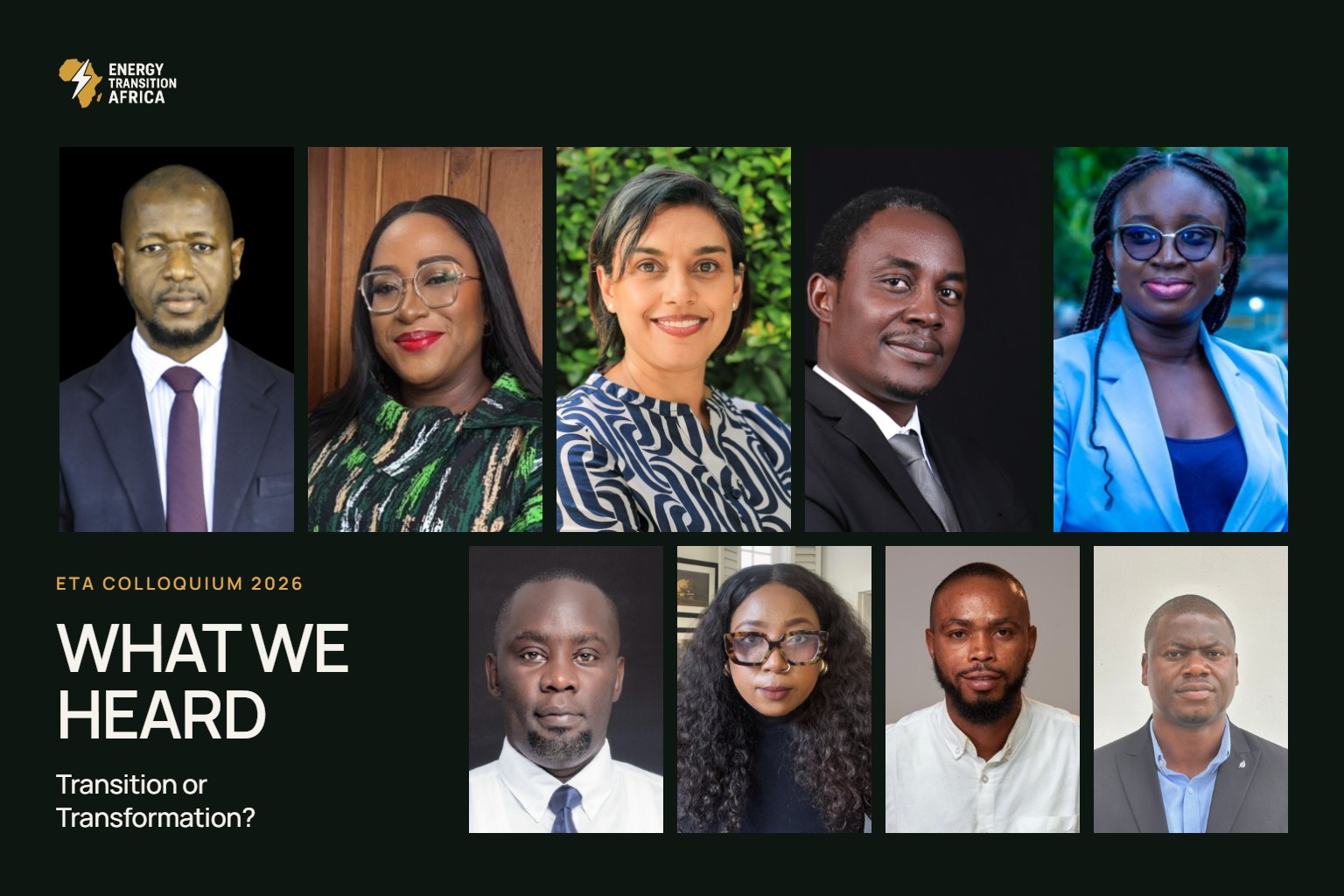
That question brought together five guest speakers and four emerging researchers at the inaugural Energy Transition Africa (ETA) Colloquium, held virtually on Thursday, 15 October 2026.
The event also marked the culmination of ETA's founding Fellows Programme. Drawn from 231 applications, the original cohort comprised 15 Fellows from eight African countries. Fourteen completed the eleven-week programme, with four presenting their research during the Colloquium.
The conversations approached Africa's energy future from different directions: continental policy, industrial development, finance, rural electrification, clean cooking, community participation and electricity system maintenance.
Three connected arguments emerged.
1. Transformation depends on who builds, runs and holds the assets
“Africa must not simply be powered by the global energy transition. Africa must help power it, shape it, and ensure that it delivers for our people.”
Yagouba Traoré, African Energy Commission, African Union
Africa's resources should drive industrialisation
Opening the Colloquium, Yagouba Traoré, Head of Policy Planning and Strategy at the African Energy Commission (AFREC), argued that Africa must move beyond supplying raw materials to the global energy economy.
He called for greater investment in local processing, refining, manufacturing, education and innovation. He also emphasised the importance of African countries strengthening their financial and institutional sovereignty, expanding regional trade and developing the skills needed to participate meaningfully in clean energy value chains.
His central argument was that Africa's energy resources must become drivers of industrialisation and economic development, rather than simply commodities supplied to external markets.
Investment builds an industry only if firms learn to compete
Ejiro Gray, Director, Governance and Sustainability at Sahara Group, brought the discussion closer to the realities of industry.
She invited participants to imagine two countries receiving comparable energy investments. A decade later, one has developed local engineering firms, skilled operators, competitive suppliers and businesses capable of expanding into new markets. The other continues to import the expertise and services required to operate its infrastructure. Both countries have added energy assets. Only one has built lasting industrial capability.
Gray identified five multipliers that can turn energy investments into wider economic value: people, African suppliers, technology, productive use, and capital and governance.
She also drew an important distinction between local content and local capability. Giving African firms access to contracts is a starting point, she argued, but transformation requires those firms to develop the competence to compete without relying indefinitely on regulatory protection.
Value can be captured now
Maybel Acquaye, Policy Lead for Minerals and Mining Policy at the Africa Centre for Energy Policy (ACEP), added a practical question: where can African countries begin capturing value now?
She pointed to opportunities in solar equipment servicing, electric two- and three-wheeler assembly, charging infrastructure, solar-powered irrigation and locally developed clean cooking value chains.
Using Ghana's clean cooking sector as an example, she described how ethanol could support not only cleaner household energy but also agricultural production, local distribution, equipment servicing and livelihoods.
Her argument was not that Africa should abandon ambitions to manufacture advanced technologies. Rather, countries should identify commercially viable opportunities available today while deliberately developing the capabilities needed for more complex production tomorrow.
An energy asset is not an energy industry
Across these contributions, one distinction became clear: building an energy asset is not the same as building an energy industry.
The development question isn't only how much electricity Africa generates or how many technologies it installs, but how much value African workers, enterprises and institutions can create and retain.
2. Finance is necessary, but so are its terms and the systems connecting capital to projects
“Acknowledging dependency is not an admission of weakness. It is the starting point for strategic collective power.”
Dr Chantal Naidoo, Founder and Executive Director, Rabia Transitions
Whose money, on whose terms
Dr Chantal Naidoo challenged participants to examine the terms on which Africa's energy transition is financed.
Her address, Whose Money, Whose Terms?, questioned financing arrangements that place substantial risks and social costs on African governments while allowing commercial investors to prioritise individually profitable assets.
She argued for a different approach: front-loading grants and concessional resources to address social impacts, negotiating regional portfolios that connect commercially attractive investments with wider development needs, and strengthening African institutions' ability to assess risk and negotiate financing terms.
The issue, she suggested, isn't simply whether more money reaches Africa, but whether financing arrangements support the economic and social transformation African countries are seeking.
Targets don't produce financeable projects
The founding Fellows' presentations brought another dimension to the financing challenge.
Edward “Teddy” Odindo, whose research examined Africa's clean cooking finance pipeline, argued that national targets and estimates of investment needs do not automatically produce financeable projects.
Drawing on Kenya's clean cooking sector, he highlighted the importance of identifying the specific constraints facing different technologies and markets, preparing credible investment propositions and tracking opportunities through due diligence, financial close and delivery.
His central question was practical: even if the required capital became available, would there be enough investment-ready opportunities capable of absorbing it?
Community money still needs a developer
Damilola Olowookere examined a different financing problem in Nigeria's Niger Delta.
His research considered host community development trusts that have allocated funds for electricity projects and undertaken preparatory work but have struggled to connect with developers willing to build in higher-cost coastal and riverine locations.
The problem is not simply an absence of community resources. It is the difficulty of connecting those resources with developers, appropriate financing structures and project delivery mechanisms.
Together, these contributions exposed two related challenges.
One concerns the terms on which external capital is provided. The other concerns the institutional work required to connect available finance with viable projects.
Mobilising money is necessary. But transformation also depends on who negotiates its terms, how projects are prepared and whether investments reach the people and places they are intended to serve.
3. What happens after installation may determine whether the transition succeeds
One of the strongest recurring themes was the difference between installing infrastructure and sustaining its performance.
Public assets need an operator after launch
Dr Bala Tyoden, Deputy Director at Nigeria's Rural Electrification Agency (REA), delivered an address on behalf of the Agency's Managing Director, Abba Abubakar Aliyu.
The address described public electricity assets that encountered operational difficulties after commissioning, including university power installations where arrangements for long-term operation and maintenance had proved inadequate.
It also outlined the Agency's evolving approach to asset sustainability, including its Renewable Asset Management Company model, interconnected mini-grids and the coordination required among developers, distribution companies, communities and regulators.
These examples illustrated why technical construction is only one part of successful electrification. Someone must remain responsible for operating the asset, maintaining equipment, collecting payments, replacing components and ensuring that electricity is used productively.
Generating electricity is not the same as delivering it
ETA Fellow Kemoh Lumei explored a related challenge in Liberia.
His research examined how electricity customers can continue experiencing frequent outages even when generation capacity is available. He focused on distribution maintenance, fault response, repair materials and the operational systems required to restore reliable service.
His presentation made an important distinction: generating sufficient electricity does not guarantee that customers receive reliable power. For transformation to occur, investment in generation must be accompanied by the institutional and technical capacity to maintain the networks delivering electricity to homes and businesses.
Public understanding is part of accountability
But infrastructure performance is not only a technical issue. ETA Fellow Nozuko Poni examined public understanding of South Africa's just energy transition.
She argued that while renewable energy projects may be required to report on jobs, procurement and community development expenditure, there is insufficient equivalent attention to whether people understand the transition, its benefits and their opportunities to participate.
She proposed making community understanding a more explicit and independently assessed part of transition accountability. Her argument raised a question that extends well beyond South Africa: can communities meaningfully participate in and take a stake in a transition they do not understand?
Across these presentations, maintenance, institutional accountability and public understanding emerged as essential dimensions of successful energy development. An installation may mark the completion of a project. It does not necessarily mark the delivery of lasting development.
Where the conversations converged, and where questions remain
Where the speakers agreed
Although the speakers approached the theme from different institutional and professional perspectives, several areas of convergence emerged.
There was broad emphasis on the need to measure energy investment by its development outcomes, not simply by installed capacity or financial commitments.
Speakers repeatedly returned to the importance of African skills, competitive enterprises, stronger institutions and the productive use of energy. They also highlighted the need to connect policy ambition with practical delivery: from investment preparation and technology transfer to maintenance arrangements and community participation.
Questions the Colloquium left open
Important questions remain. How should African countries balance the speed of infrastructure deployment with the time required to develop local capabilities?
What financing arrangements can support commercial investment without leaving governments and communities to bear disproportionate risks? How can countries sequence natural gas, renewables, storage and electricity network expansion while safeguarding long-term development objectives?
And how should governments measure transformation itself: through jobs, competitive enterprises, reliability, community understanding, institutional performance or a combination of these outcomes?
The Colloquium did not resolve these questions. Nor was it intended to produce a single position endorsed by every speaker. Its contribution was to bring different perspectives into a common discussion and clarify the choices that require further analysis.
The founding Fellows: research beyond the Colloquium
The Colloquium also celebrated the completion of ETA's inaugural Fellows Programme. Over eleven weeks, participants engaged with faculty, examined published evidence, developed research arguments and worked on original analyses addressing practical challenges in Africa's energy transition.
Four Fellows presented their research live. Edward “Teddy” Odindo of Kenya presented From Targets to Transactions: Fixing Africa's Clean Cooking Finance Pipeline. Nozuko Poni of South Africa examined public understanding, community participation and accountability in the just transition. Damilola Olowookere of Nigeria looked at connecting host community development trust resources with off-grid electricity investment in the Niger Delta. Kemoh Lumei of Liberia examined operations and maintenance bottlenecks affecting electricity distribution reliability.
The remaining Fellows also developed analyses addressing energy policy, finance, institutions, technology and development challenges across the continent. Their research will form part of ETA's continuing work to bring African evidence and perspectives into public discussion.
What comes next
The inaugural Colloquium marks the beginning of a continuing conversation. Energy Transition Africa will prepare a Colloquium Brief examining the principal arguments, areas of convergence, unresolved questions and implications for policy and practice.
ETA will also publish the founding Fellows' signature analyses as they complete the editorial and evidence-verification process. Selected recordings and speaker materials will be made available through ETA's communication channels as they are prepared for publication.
For ETA, these activities form part of a larger institutional commitment: connecting research, people and institutions to the opportunities of Africa's changing energy economy. As ETA Executive Director Vincent Egoro observed in his opening address:
“A transition changes where a country gets its energy. A transformation changes what a country is able to do.”
That distinction will continue to guide ETA's work. Africa's energy future will be shaped not only by the infrastructure built or the investment mobilised, but by the capabilities developed, the institutions strengthened and the opportunities created for its people.
The Colloquium has ended. The work continues.
Energy Transition Africa thanks the guest speakers, founding Fellows, faculty, moderator Deborah Bonney, Board, team and participants who contributed to its inaugural Colloquium.