IEA 2026: Africa's Minerals Are Rising. Its Refining Capacity Is Not.
There is a version of Africa's critical minerals story that the continent tells itself at every summit, strategy document, and in every statement of intent from Abidjan to Windhoek. It goes like this: Africa holds the minerals the world needs for the clean energy transition; global demand is rising; the continent's moment has arrived; and this time will be different.
But the version the IEA tells in its Global Critical Minerals Outlook 2026 is more complicated, specific, and more useful.
It confirms that Africa is becoming more important to the global mineral economy. The Democratic Republic of the Congo and Zambia are together the largest single contributors to narrowing the world's copper supply gap. The DRC's cobalt export quota is now, by the IEA's own account, the central variable in whether the global cobalt market runs a surplus or a deficit. Madagascar, Mozambique, and Tanzania could collectively supply roughly one-third of the world's mined natural graphite by 2040, up from approximately 11 percent in 2025. African lithium output rose 44 percent in 2025 alone. Zimbabwe commissioned the continent's first lithium refining facility in the first half of 2026.
The same report documents that China is projected to account for approximately 90 percent of battery-grade graphite production in 2040, and the average share held by the leading refining country across all key energy minerals reached 72 percent in 2025. The top three refining nations collectively account for 86 percent of the refined mineral supply, and China remains the dominant supplier of refined minerals for virtually every mineral the IEA tracks, regardless of where the ore was mined.
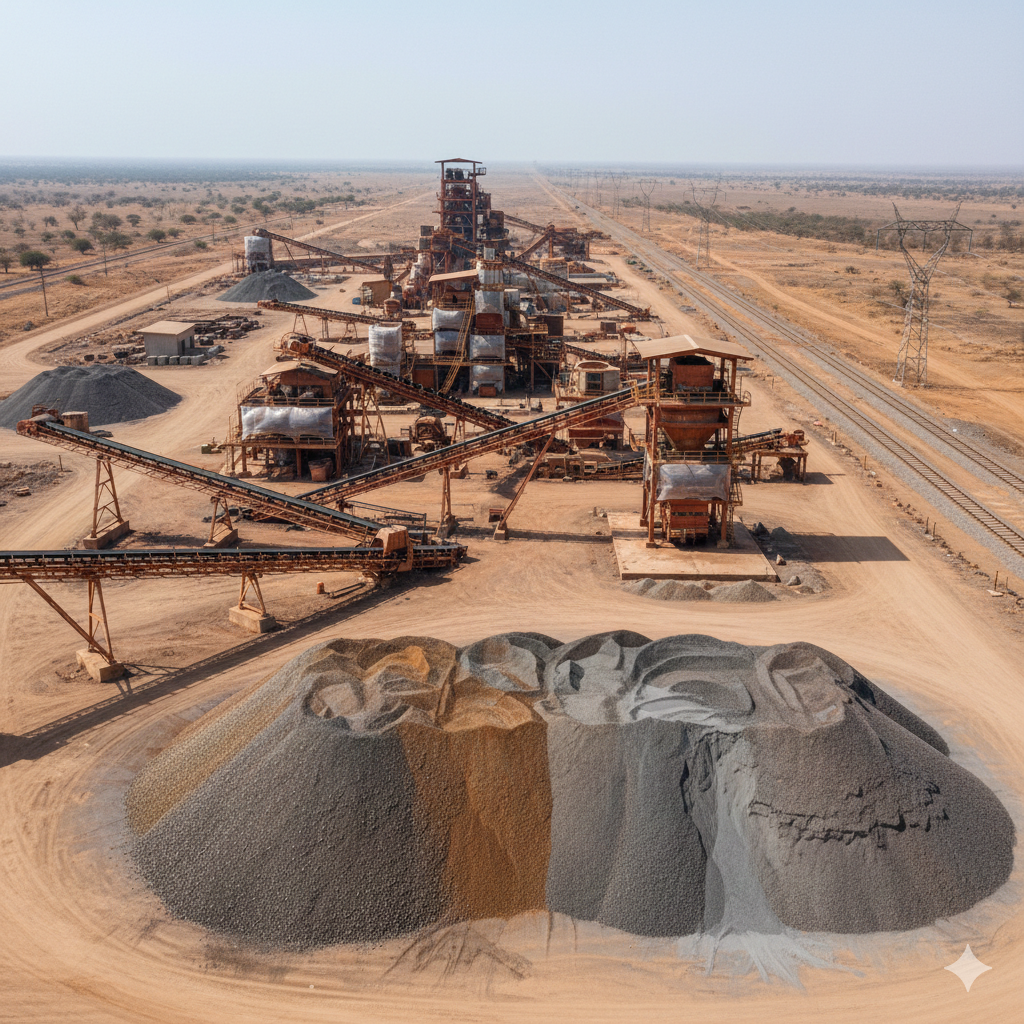
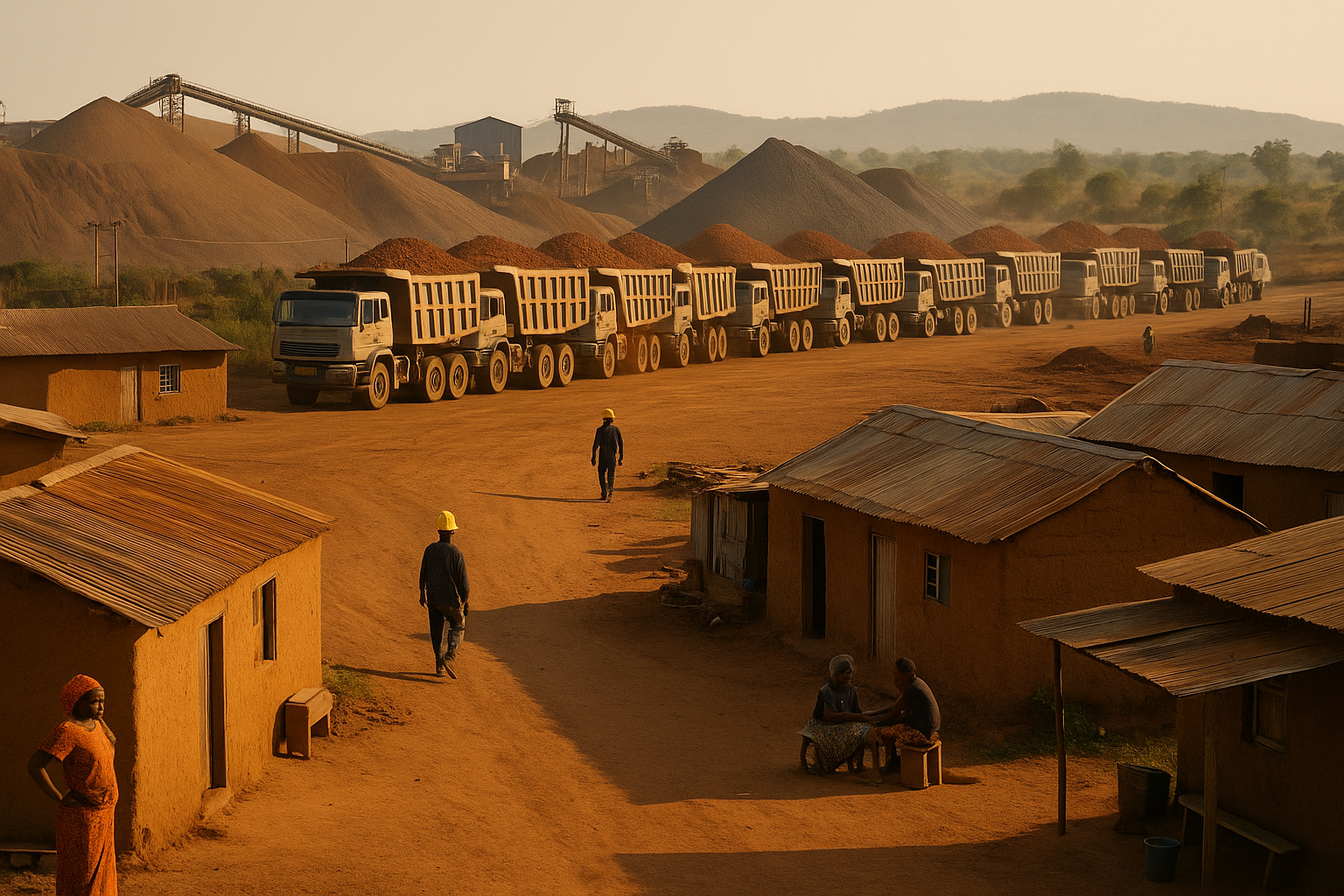
Africa mines more, while the world processes more of it. The two facts are not in tension; instead, they describe the same supply chain from opposite ends.
Cobalt: the DRC has real market power, and real limits
The DRC produced approximately 320,000 tonnes of mined cobalt in 2025. That is roughly two-thirds of the world's supply from a single country. When the government imposed an export ban in February 2025, it then replaced it in September with a quota system capping exports at 96,600 tonnes, less than half of 2024's production volume. Cobalt metal prices responded by approaching USD 58,000 per tonne in early 2026, more than three times the level of a year earlier. In April 2026, the government went further, establishing a strategic mineral reserve with the discretionary power to withhold or release volumes depending on prevailing prices. The IEA's base case now shows the cobalt market moving into structural deficit from 2026 onward.
This is evidence of real, structural market power. Decisions made in Kinshasa can and do move battery, electronics, aerospace, and defence supply chains worldwide, which isn't a small thing. In a world where supply concentration is intensifying, the country that controls two-thirds of a critical mineral's global output holds a form of leverage that most countries will never possess.
But the IEA's data also illustrates why controlling supply isn't the same as controlling a value chain. Cobalt hydroxide inventories accumulated inside the DRC as companies faced uncertainty over allocations, and the quota framework beyond 2027 remained unclear at the time of publication. Production that can't be exported or processed domestically becomes stock, not industrial leverage. And the IEA projects that DRC cobalt output will begin declining by approximately 5 percent annually from 2030 as ore quality diminishes, a trajectory no other producer is currently positioned to offset, but one that narrows the window in which the DRC's market power can be converted into something more durable.
The lesson is that a restriction creates scarcity. An industrial strategy converts scarcity into processing infrastructure, technology acquisition, and employment.
Copper: Africa narrows the world's supply gap
The global copper market faces a projected supply deficit of around 25 percent by 2035 under current policy settings, an improvement on the 30 percent gap projected in the previous IEA Outlook, and Africa is the largest contributor to that improvement. The DRC and Zambia together are projected to add almost 650,000 tonnes of copper supply by 2035 beyond what last year's assessment assumed, driven by expansion at the Kisanfu operation in the DRC and the Lumwana mine in Zambia. Copper prices have already surged past USD 14,000 per tonne in 2026, and the Copperbelt's strategic importance has never been higher.
A supply deficit doesn't automatically translate into African industrialisation. Higher prices can increase export earnings and fiscal revenues while simultaneously reinforcing the incentive to move concentrates and cathodes rapidly into established manufacturing centres in Asia and Europe. The opportunity the IEA's data opens is: use copper scarcity as negotiating leverage for investment in regional smelting, cable production, transformer manufacturing, and electrical equipment. The DRC already has substantial hydrometallurgical copper production. Zambia has mining expertise, industrial infrastructure, and a long-established Copperbelt economy. Together, they offer the basis for a regional industrial cluster. Whether they build one or remain two isolated national export strategies is a governance question, not a geology question.
Graphite: the clearest structural imbalance in the report
In the IEA's base case, natural graphite production in Madagascar, Mozambique, and Tanzania rises from a combined 199,000 tonnes in 2025 to approximately 816,000 tonnes by 2040, a more than fourfold increase, lifting their combined share of world mined production to roughly one-third. This is among the fastest growth trajectories for any African mineral in the report.
This is the distinction that matters and that the mining-boom narrative consistently obscures. Natural graphite concentrate isn't an electric-vehicle battery input. Before it becomes battery-grade anode material, it must be purified, shaped, spheroidised, and coated, each stage requiring specialised equipment, chemical inputs, intellectual property, quality-control systems, certification, and established relationships with battery manufacturers. Without those capabilities, Africa will mine graphite from one-third of the world's deposits while capturing a fraction of the value those deposits represent.
Mozambique's June 2026 measures, requiring local processing and directing 10 percent of mining revenues to local communities, represent an effort to change that model. But a local-processing mandate succeeds only when it is backed by competitive power, reliable infrastructure, technology partners, and committed buyers. A mandate without those supporting conditions is a legislative statement, not an industrial strategy.
Sulphuric acid: the vulnerability nobody is talking about
One of the IEA's most important Africa-specific findings concerns a material almost absent from the continent's critical minerals debate: sulphuric acid.
Approximately 45 percent of the DRC's copper production uses acid-based hydrometallurgical leaching. With close to 1.5 million tonnes of copper output exposed to this process, and acid accounting for roughly 20 percent of production costs given the composition of Congolese ores, any disruption to sulphur supply creates a direct threat to African copper output even when the mineral deposits themselves remain entirely secure. Disruptions to sulphur supplies from the Middle East, combined with restrictions on Chinese sulphuric-acid exports, translate into a copper and cobalt vulnerability that sits completely outside the standard minerals-strategy conversation. Zambia faces comparable exposure, though regional supply relationships provide partial protection.
This reveals a structural truth about mineral sovereignty that the grand declarations tend to ignore: it depends not only on what is beneath the ground but on control over industrial inputs. A Copperbelt strategy that accounts for cobalt quota policy and copper price trajectories while ignoring acid supply is not yet an industrial strategy. It is an extraction plan with more sophisticated framing.
What Africa should take from this report
The IEA's data produces a finding that is uncomfortable and actionable in equal measure: the world increasingly needs African minerals, and controls what happens to them after they leave the continent.
Four African governments, the DRC, Zimbabwe, Mozambique, and South Africa, used trade policy as a deliberate lever for value capture within a single year, a pattern rather than a collection of isolated decisions.
But the IEA also projects that in 2035, China will supply over 60 percent of refined lithium and cobalt, and approximately 80 percent of battery-grade graphite. The average share of the top three refining nations is projected to decline only marginally over the next decade, effectively returning to 2020 concentration levels, despite a decade of diversification rhetoric.
The IEA's own data strengthen Africa's negotiating case in a way that African governments should be using more aggressively. Critical minerals represent approximately 3 percent of the cost of an average electric vehicle. Rare earths account for less than 1 percent of a vehicle's value, and a tripling of rare earth prices would raise the cost of a car by approximately 0.1 percent. Global manufacturers can afford long-term contracts, price floors, and premiums for minerals produced with local processing and environmental accountability, if African governments ask for them and structure agreements that enforce the ask.
The mineral-security premium that importing economies are willing to pay to diversify supply chains is real, and it is growing. The IEA documents that public-finance commitments for critical minerals in advanced economies reached approximately USD 65 billion in 2025, more than four times their 2023 level, while private investment fell. Wealthy governments are underwriting their own supply chain diversification. Africa should make it a condition that part of that underwriting finances African processing, not merely a new generation of export mines.
The continent's geological position has never been stronger. The conversion of that position into industrial capacity, employment, and retained economic value remains the work that matters. The IEA's 2026 Outlook confirms both how significant Africa's mineral endowment is and how far the distance remains between endowment and transformation.
That distance won't be closed by the next summit declaration. It will be closed, if it is closed at all, by the next refinery, processing agreement, the next regulatory framework designed to enforce what is promised in joint statements, and by the people with the technical and institutional capacity to build, negotiate, and sustain those things over the decades they require.