Africa's Generator Economy Is Bigger Than Most National Utilities
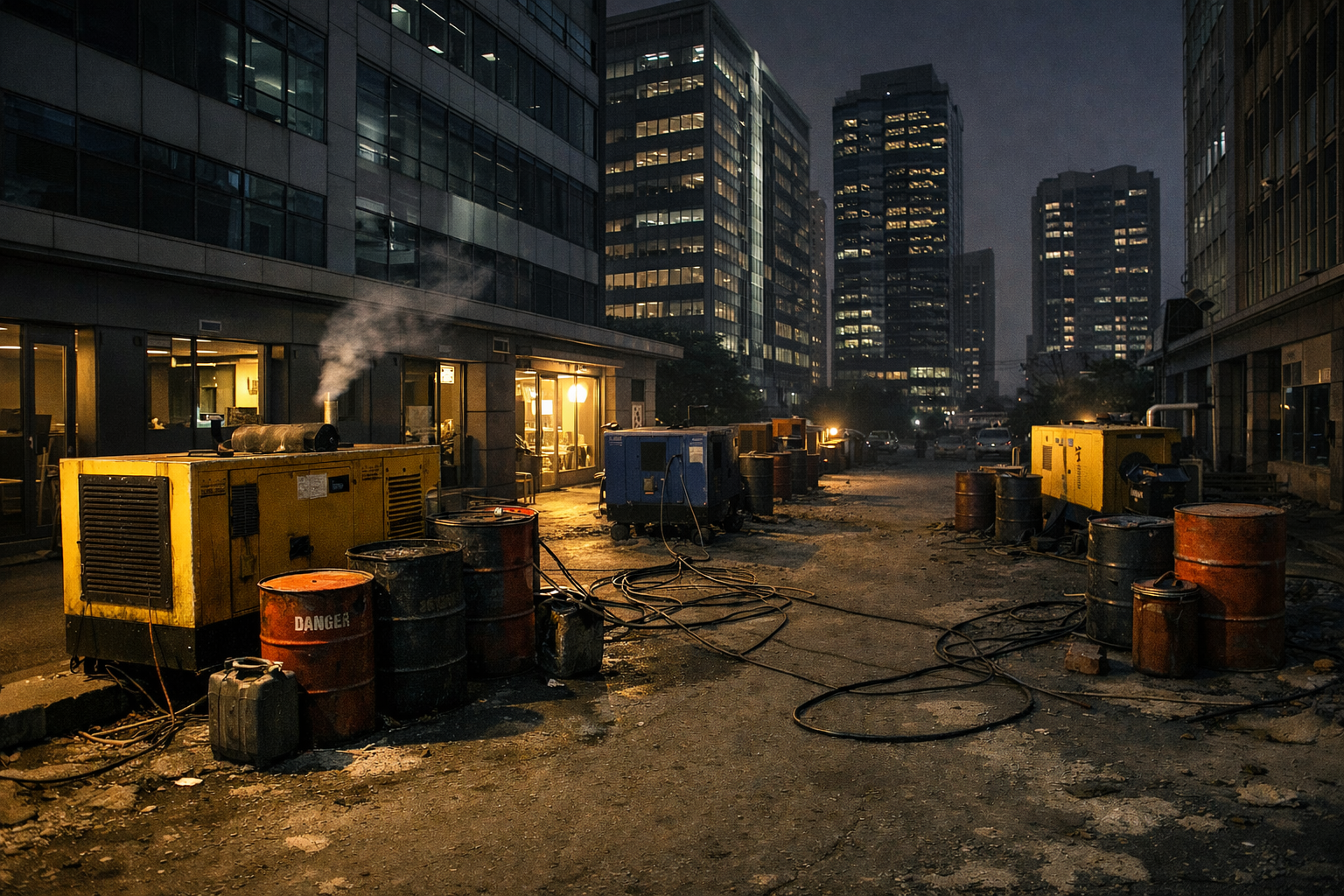
Every serious conversation about Nigeria’s energy transition eventually arrives at the same diagnosis: the grid is unreliable, investment is insufficient, and the country loses billions of dollars annually to self-generated power.
All of that is correct. But it stops just short of another important observation. Nigeria doesn't simply have a generator problem. It has a generator economy, a parallel energy system with its own supply chains, financing relationships, maintenance networks, trade associations, import lobbies, and political economy.
That economy is estimated to be worth $14 billion annually in generator hardware and fuel spending, according to the Central Bank of Nigeria. It employs hundreds of thousands of people across sales, maintenance, fuel distribution, and logistics. It has organised interests, balance sheet depth, and proximity to decision-makers.
And it is structured, whether by design or by consequence, to perpetuate the conditions that sustain it. This is the mechanism that most analyses of Nigeria’s energy transition don't fully map. The question isn't simply whether solar can outcompete diesel on cost, but if the political economy built around diesel can be displaced by the political economy required for grid and renewable investment. Those are different contests, operating on different timelines, with different actors and incentives.
Inside Nigeria’s generator market: scale, structure, and growth
To understand why the generator economy resists displacement, it helps to look closely at its scale.
Nigeria’s diesel genset market was valued at approximately $548 million in hardware terms in 2023 and is projected to reach $849 million by 2029, growing at a compound annual rate of 7.4 percent. That is the formal market. The informal economy, grey imports, unregistered technicians, and untracked fuel distribution are significantly larger.
Grid instability reinforces demand. Nigeria’s grid collapsed twelve times in the first half of 2024 alone, with continued failures into 2026. Across Sub-Saharan Africa, outages averaged 56 hours per month in 2024. In Nigeria’s industrial clusters, that figure regularly exceeds 200 hours.
Every outage is a signal to invest in generators. The ecosystem supporting that demand is dense and well-established. Companies such as Mikano, Mantrac, and Jubaili Bros operate nationwide distribution networks with integrated financing, spare parts logistics, and maintenance services. Global manufacturers, Caterpillar, Cummins, Perkins, and Kohler, are embedded in these supply chains.
Fuel distribution extends from import terminals in Apapa through formal and informal retail networks. Each node represents revenue, employment, and political connections. This is not an informal workaround, but an organised industry.
How generators compete with the grid for capital and talent
The competition between Nigeria’s generator economy and its energy transition isn't abstract, but material, and it plays out across capital, talent, and finance.
First, capital. Businesses that have already invested heavily in generators are locked into those decisions. A manufacturer in Lagos operating two 500-kVA generators may have spent $100,000 on procurement and another $50,000 annually on maintenance. That investment doesn't disappear when grid reliability improves.
Switching requires writing off sunk costs or repurposing assets, both economically difficult decisions. At scale, this creates inertia across the economy that standard energy statistics do not capture.
Second, talent. Generator maintenance is a mature technical field in Nigeria. Thousands of technicians are trained on platforms such as Caterpillar and Cummins, working within distributor networks or independent workshops. The energy transition requires a different skill base of grid operators, protection engineers, and solar technicians, but that pipeline is less developed.
In effect, a large share of Nigeria’s available energy-sector talent is already committed to sustaining infrastructure that the transition seeks to replace.
Third, financing. Generator procurement is supported by well-established financing channels, such as commercial bank loans, leasing arrangements, and distributor credit facilities. These are familiar, predictable, and tailored to existing demand.
Renewable energy financing, even at the commercial and industrial scale, requires different structures, risk assessments, and institutional familiarity. The result is clear; the financing system understands generators, but is still learning about renewables.
The politics behind the generator economy
The generator economy is not just economic, but also political. Major distributors have operated in Nigeria for decades, building institutional relationships with ministries, regulators, and legislative actors. Fuel importers, often part of larger petroleum conglomerates, have a direct interest in maintaining diesel demand at scale.
Policy decisions reflect these realities. For years, fuel subsidies effectively lowered diesel costs, making generator use artificially competitive relative to alternatives. Even after subsidy removal, the structural advantage built over time remains embedded.
Industries with organised interests tend to advocate for policies that sustain their viability. The generator economy doesn't need to oppose renewable energy directly; it only needs to support policies that preserve its operating conditions, import structures, fuel availability, and regulatory thresholds that don't penalise emissions.
Individually, these policies are defensible. Collectively, they reinforce the incumbent. Against this backdrop, Nigeria’s grid struggles to compete. Distribution companies operate with liquidity constraints. Transmission remains underfunded. Maintenance backlogs persist.
The generator economy offers something the grid doesn't: Reliability, delivered privately, without dependence on a fragile public system.
Why Nigeria’s energy transition will be decided here
Much of Nigeria’s energy transition discourse is dominated by announcements of renewable targets, investment commitments, and megawatts added. While these matter, they aren't decisive.
The transition will be determined by whether the conditions sustaining the generator economy are dismantled or allowed to persist while renewable capacity is layered on top. At present, what is emerging isn't displacement, but coexistence.
Solar panels installed on factory rooftops while diesel generators continue to power core operations don't constitute a transition. They represent a supplement.
A true transition requires something more difficult. It requires the incumbent system to be displaced. And displacement isn't a technical challenge but a structural one. The generator economy competes directly for the same resources, capital, talent, and policy attention that the transition requires. And until that competition is resolved, renewable deployment alone will not change outcomes.
What would actually shift the system
None of this argues that the generator economy can be administratively shut down or that its participants are acting in bad faith. They are responding rationally to a grid that has failed them, and the infrastructure they have built fills a real gap.
The argument is narrower and more actionable: policies aimed at accelerating Nigeria's energy transition need to be designed with explicit awareness of the incumbent's structural position. Import duty structures on solar and storage equipment need to be competitive with the effective cost of generator procurement.
Financing products for commercial and industrial renewable installations need to be as accessible and well-understood as the generator leasing arrangements that businesses currently use. The skills pipeline for solar installation, grid maintenance, and protection engineering needs to be developed at the same pace as generation capacity. And the regulatory frameworks governing industrial self-generation need to create incentives for the switch to cleaner alternatives rather than simply accommodating existing arrangements.
The generator economy won't be displaced by cheaper solar; instead, by a combination of policy, financing, and skills infrastructure that makes the transition economically coherent for the businesses and households that are currently its customers. Until that combination is assembled with the same deliberateness that built the incumbent, the energy transition in Nigeria will continue to be announced at summits and deferred on factory floors.
Conclusion: the transition is competing with an economy, not a problem
Nigeria’s energy transition is often framed as a technical challenge: how to generate more power, deploy renewables, and stabilise the grid.
But the reality is more complex because the transition isn't competing with a gap, but with an economy. An economy that is organised, profitable, and embedded in the country’s institutional and political structures.
Until that is recognised, progress will remain partial.
Nigeria’s generator economy isn't just a symptom of grid failure. It is a stakeholder in the system that sustains it.