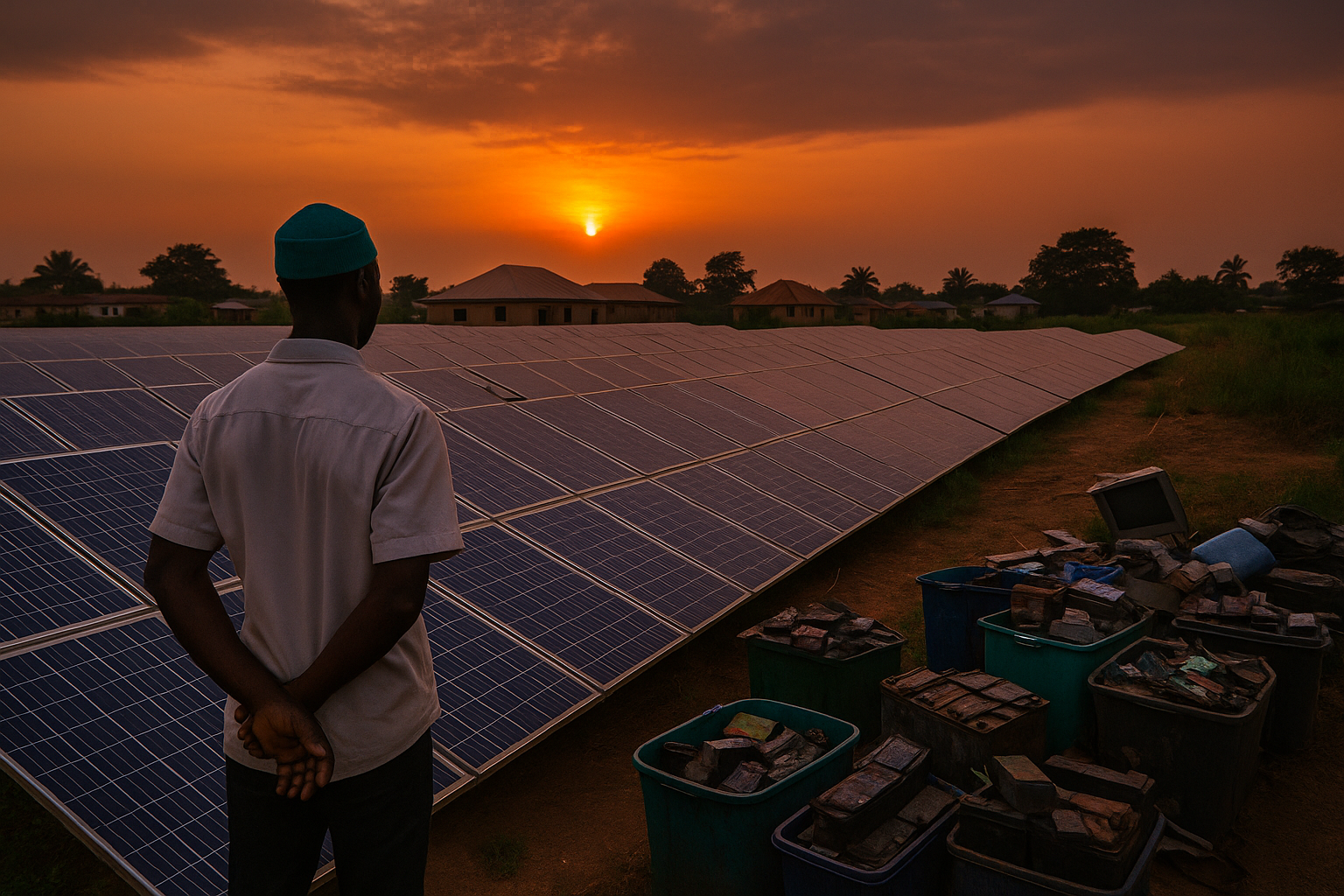
Nigeria Is Betting Its Energy Transition On Carbon Capture. The Economics Do Not Yet Add Up.
Nigeria's carbon storage potential is real. The commercial logic for deploying it is far less certain.
According to the 2025 CO₂ Storage Atlas backed by the International Finance Corporation (IFC), Nigeria holds an estimated 10.7 gigatonnes of potential underground carbon storage capacity, concentrated within depleted reservoirs and deep saline aquifers in the Niger Delta. On paper, this positions Nigeria as a future leader in carbon management infrastructure.
Yet the country still has no commercial Carbon Capture, Utilisation and Storage (CCUS) project in operation.
This gap exposes a deeper contradiction inside Nigeria's transition strategy. The country is attempting to reconcile two competing realities: a formal commitment to achieve net zero emissions by 2060, and an economy structurally dependent on oil and gas revenues. CCUS has emerged as the political bridge between those realities, promising a way to reduce emissions from heavy industry without immediately dismantling fossil fuel production.
Globally, however, deployment remains limited. The Global CCS Institute reported in 2025 that only 77 commercial CCUS facilities were operational worldwide, collectively capturing around 64 million tonnes of CO₂ annually. The International Energy Agency (IEA) projects that even under aggressive decarbonization scenarios, CCUS contributes less than 5% of cumulative emissions reductions by 2050.
CCUS is not a broad substitute for energy transition. It is a narrow industrial tool for hard-to-abate sectors: cement, fertiliser, petrochemicals, and parts of heavy industry. The real question is not whether Nigeria can technically store carbon underground. It is whether CCUS is being designed as a disciplined transition mechanism or as a political instrument that allows the oil economy to continue largely unchanged.
The Niger Delta and the problem of trust
The operational centre of any Nigerian CCUS industry would almost certainly be the Niger Delta. The same geological formations that produced decades of oil extraction are now being assessed as long-term carbon storage reservoirs (IFC & World Bank Group, 2025).
This creates an immediate social and political problem.
For more than six decades, the Niger Delta has absorbed the environmental costs of Nigeria's hydrocarbon economy. Oil spills, gas flaring, pipeline leaks, and weak regulatory enforcement have produced deep distrust toward both the state and multinational operators. Any new energy infrastructure project proposed in this landscape arrives with a profound historical deficit of trust.
Communities are not only asking whether the technology works. They are asking what will fundamentally change for them. Will CCUS create local jobs, improve environmental monitoring, and generate shared economic value? Or will it become another mechanism through which industrial risks are concentrated locally while economic gains flow elsewhere?
This matters economically as much as politically. Global infrastructure investors increasingly treat community instability as a financing risk. In Nigeria, social licence is not a secondary public relations issue. It is directly tied to whether projects can attract long-term capital at commercially viable rates.
The current framework under the Petroleum Industry Act (PIA) of 2021 establishes Host Communities Development Trusts, mandating that oil companies dedicate 3% of annual operating expenses to local communities. This model has faced criticism for treating communities as passive beneficiaries rather than active structural partners.
To secure genuine social licence, a Nigerian CCUS framework must go further: transparent monitoring systems accessible to local communities, clearly defined long-term liability structures, and benefit-sharing mechanisms tied to carbon revenues. Without those protections, even technically viable projects could struggle to move beyond feasibility studies.
The EOR contradiction
The most important tension inside Nigeria's CCUS strategy lies in how captured carbon is ultimately used.
Official policy framing emphasises permanent geological storage (IFC & World Bank Group, 2025). But within the oil industry, depleted reservoirs are also valuable because injected CO₂ can increase oil recovery rates through Enhanced Oil Recovery (EOR). By repressurising mature fields and reducing oil viscosity, CO₂ injection allows operators to extract additional crude from declining assets (Omefe et al., 2025).
Pure carbon storage is expensive. International estimates place capture, transport, and storage costs between $50 and $100 per tonne (IEA, 2024). Meanwhile, voluntary carbon markets still trade credits near or below $20 per tonne (ACMI, 2024). This gap makes standalone storage commercially difficult. EOR changes the equation by generating additional oil revenues that can partially offset those costs.
Two international precedents frame the choice Nigeria faces:
The United States (Section 45Q): The Inflation Reduction Act offers a lower credit for CO₂ used in EOR ($60 per tonne) and a higher premium for dedicated saline aquifer storage ($85 per tonne) (U.S. Internal Revenue Service, 2022). This built out thousands of kilometres of CO₂ pipelines in the Permian Basin but also meant early capture infrastructure became structurally dependent on oil extraction (IEA, 2024).
The North Sea (Norway/UK): Norway leveraged an aggressive offshore carbon tax from the early 1990s. Projects like Equinor's Sleipner and the Northern Lights initiative bypassed EOR entirely, directing captured emissions into deep saline formations (Equinor, 2024). Where the regulatory penalty for emitting is sufficiently high, operators opt for permanent disposal over commercial recycling through oil fields.
If Nigeria allows EOR-linked projects to dominate early deployment without strict lifecycle accounting rules, carbon policy could unintentionally subsidise additional fossil production under a decarbonization label. Operators may legally classify projects as emissions-reducing while the additional oil produced generates downstream combustion emissions elsewhere in the value chain.
The technology can either function as a limited industrial decarbonization tool or become a mechanism that extends the commercial life of hydrocarbon assets while preserving the appearance of transition.
The economics: market reality and capital allocation risks
The economic case for CCUS in Nigeria rests on one crucial assumption: that emerging carbon markets can make carbon capture commercially self-sustaining. Current policy discussions point to the Africa Carbon Markets Initiative (ACMI), where offsets are projected to trade around $20 per metric tonne (ACMI, 2024).
The numbers do not support that assumption. Capturing, transporting, and storing one tonne of CO₂ costs between $50 and $100 for diluted industrial sources, and rarely below $40 to $60 even for high-concentration sectors (IEA, 2024). A $20 voluntary credit cannot cover basic operational costs, much less the capital expenditure required for compression facilities and deep-well injection infrastructure.
If commercial markets cannot bridge this gap, early CCUS projects will require extensive state intervention. Without a rigorous benefit-sharing framework, private operators capture the financial upside while the public treasury carries the long-term liability, repeating older structural mistakes in Nigeria's resource governance.
The institutional bottleneck
Nigeria's regulatory challenge is not a lack of policy ambition. The Climate Change Act of 2021, the Energy Transition Plan, and the National Council on Climate Change together provide a substantial legislative architecture. Yet the result is a paradox: an abundance of policy text alongside a complete absence of operational project licenses.
The bottleneck is institutional. The problem is fragmentation.
The Nigerian Upstream Petroleum Regulatory Commission (NUPRC) approaches CCUS through the logic of reservoir management. Its institutional culture is optimised for licensing extraction, not permanent disposal. Without a finalised legal framework for long-term CO₂ storage liabilities, specifically regarding who owns the subsurface risk 50 years after a well is capped, it cannot issue bankable injection permits.
The Nigerian National Petroleum Company (NNPC) remains oriented toward sustaining hydrocarbon production. Its capital allocation is tethered to liquid hydrocarbon volumes, which means funding carbon disposal infrastructure structurally loses out to funding oil production.
The Federal Ministry of Environment and the National Council on Climate Change focus on emissions accounting and climate governance, with no unified inter-agency mechanism to track how captured CO₂ is legally handed off to an upstream operator for subsurface disposal.
As a result, Nigeria still lacks a unified framework governing pore space ownership, long-term storage liability, monitoring and verification standards, and carbon transfer protocols. For investors, these gaps are critical. No major institution will commit hundreds of millions of dollars to storage infrastructure when responsibility for future leakage, monitoring obligations, or accounting disputes remains unresolved.
What a first Nigerian CCUS project could actually look like
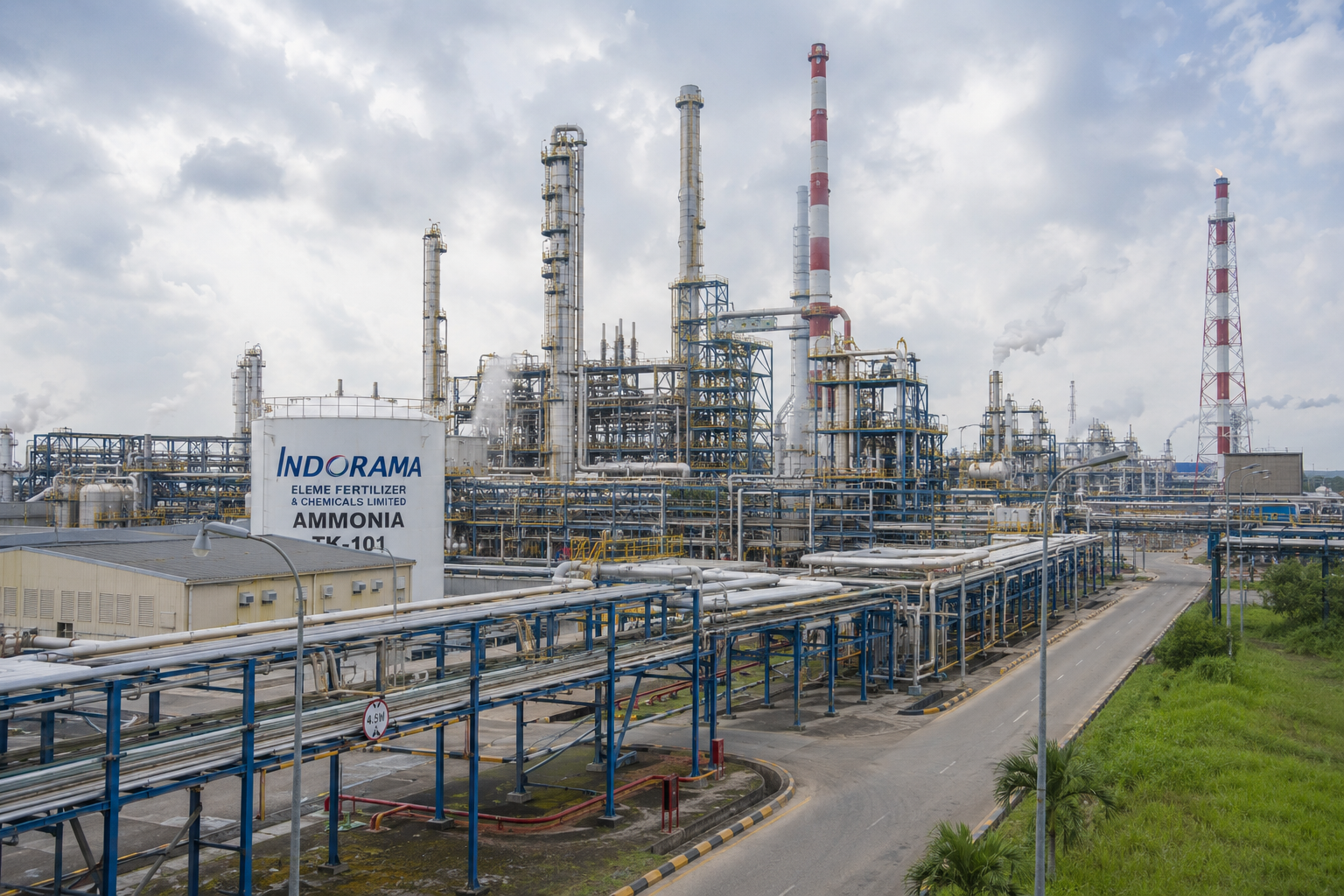
The most plausible pathway for Nigeria's first commercial CCUS project is the Onne Eleme industrial corridor in Rivers State. The area combines concentrated industrial emissions, existing pipeline infrastructure, proximity to mature reservoirs, and relatively extensive geological data.
Facilities such as Notore and Indorama already produce high-concentration CO₂ streams from fertiliser and petrochemical operations, making capture technically easier and cheaper than diluted emissions from power generation.
A realistic pilot would begin modestly: a single industrial capture hub, retrofitted pipeline transport, and injection into a mature, depleted reservoir with established geological records.
Its real significance would be institutional. A successful pilot would test whether regulators can coordinate licensing, whether monitoring systems function credibly, whether communities accept long-term storage operations, and whether blended financing can support deployment economically.
The first Nigerian CCUS project would not primarily be a climate experiment. It would be a governance experiment.
Conclusion
Nigeria's CCUS debate is ultimately not about geology. The country possesses substantial storage potential and a concentration of industrial sectors where carbon capture could technically reduce emissions. The real question is political and economic.
Carbon prices remain too weak to independently sustain large-scale deployment. Institutional responsibilities remain fragmented. The strongest commercial case for early deployment still sits dangerously close to enhanced oil recovery.
CCUS has a role in Nigeria's transition. Certain industrial sectors will likely require carbon management if the country intends to industrialise while reducing emissions intensity. But it is not a national transition strategy. It is a specialised industrial instrument operating inside a political economy shaped by oil dependence, state revenue pressures, and global climate diplomacy.
If Nigeria fails to impose strict regulatory boundaries, CCUS could become less a bridge to transition than a mechanism for prolonging the economics of the oil era under a lower carbon label.