Nigeria's Solar Batteries Are Cheap. Nobody Has Priced the Lead.
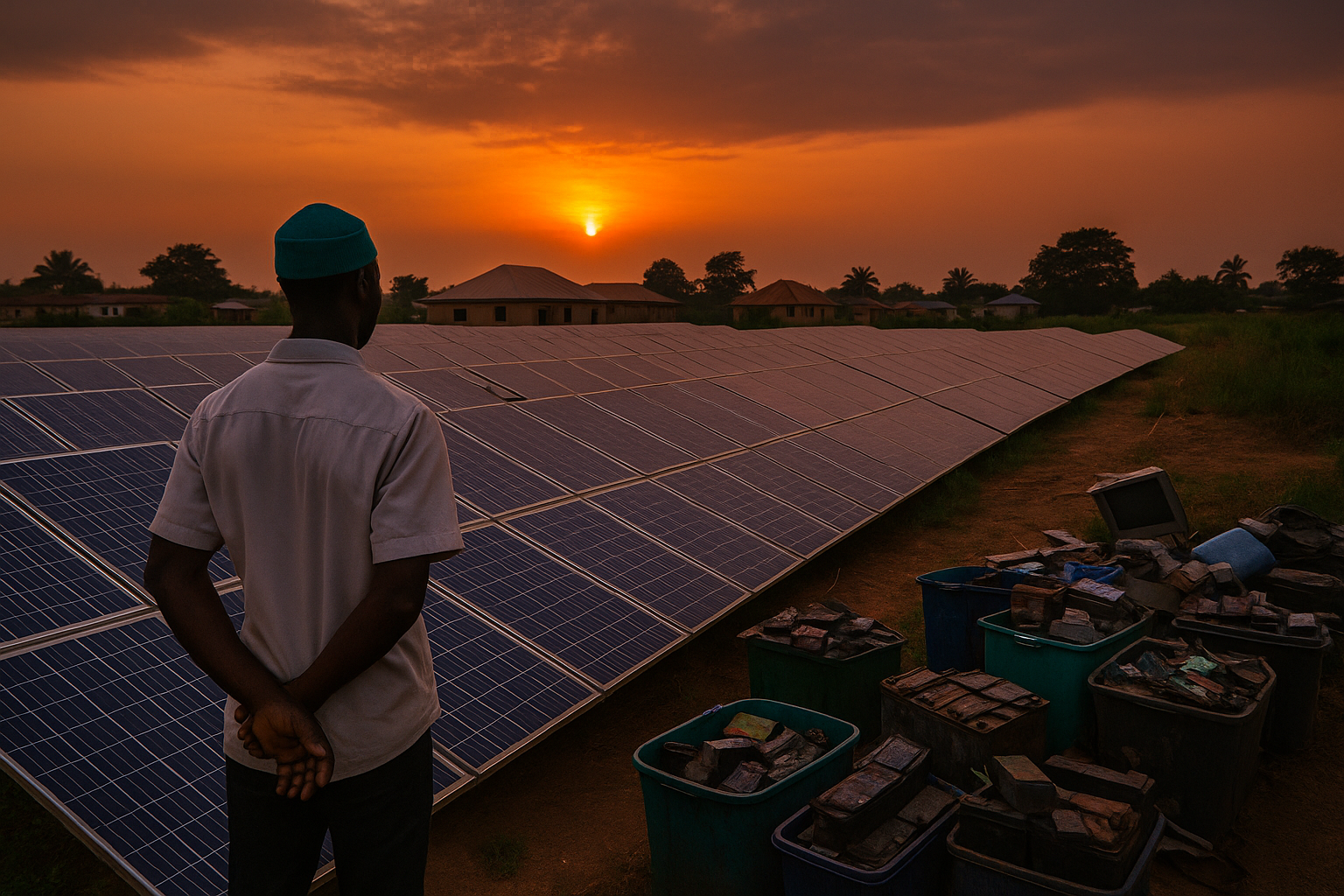
Lead-acid batteries dominate Nigeria's off-grid solar market for one reason: they are cheaper than any alternative. ETA has already established that, as well as what happens when they fail, entering a recycling system whose health costs are now internationally documented. But neither piece asked the question that precedes both of them.
Where does the lead inside a new battery actually come from? Nobody, not NESREA, not the manufacturers, and not the international buyers who eventually take delivery of Nigerian lead, currently publishes an answer with the precision the question deserves.
That gap matters more than it looks, because a price comparison that makes lead-acid batteries look affordable is only honest if the lead priced into that comparison reflects what recovering it safely actually costs. If a meaningful share of Nigeria's lead instead moves through recovery routes that externalise those costs onto workers and nearby communities, "affordable" is measuring the wrong thing.
The affordability story ETA has already told
Entry-level lead-acid solar batteries in Nigeria sell for roughly $128 to $185 per kilowatt-hour, against $142 to $215 for the cheapest lithium iron phosphate alternatives. That gap, documented in ETA's earlier analysis of why lead-acid still dominates Nigeria's off-grid solar market, is decisive for households whose energy budgets are measured in tens of dollars, not hundreds.
The consequence is a rapidly growing stream of used batteries entering a recycling system whose health costs became internationally visible in 2025, when an investigation by The Examination, the New York Times, and Premium Times documented lead poisoning among residents of Ogijo, Ogun State, and traced recycled Nigerian lead into the supply chains of major automakers. ETA covered that investigation and its regulatory aftermath in the second piece of this series. Both pieces treat the lead entering Nigeria's battery supply as a given, a commodity, priced, available. This analysis tests that assumption.
What the cost comparison leaves out
Standard price comparisons between battery chemistries treat lead as a stable input priced at prevailing commodity rates. That assumption holds only if the lead supplying Nigeria's battery manufacturers is recovered and refined under conditions whose real costs, worker safety, emissions control, and environmental remediation, are actually reflected in what recyclers charge for it.
If a meaningful share of that lead instead moves through recovery routes that externalise those costs onto workers and communities, the affordability advantage lead-acid holds over lithium-ion isn't simply a function of chemistry and manufacturing scale. It is partly a function of an input priced below what its safe recovery would cost. Testing that requires tracing the supply chain itself, not assuming the price is neutral.
A formal sector that has grown, and a split nobody has measured
The clearest fact available is that Nigeria's formal recycling capacity looks nothing like it did a decade ago, and that the picture has still not been mapped in full.
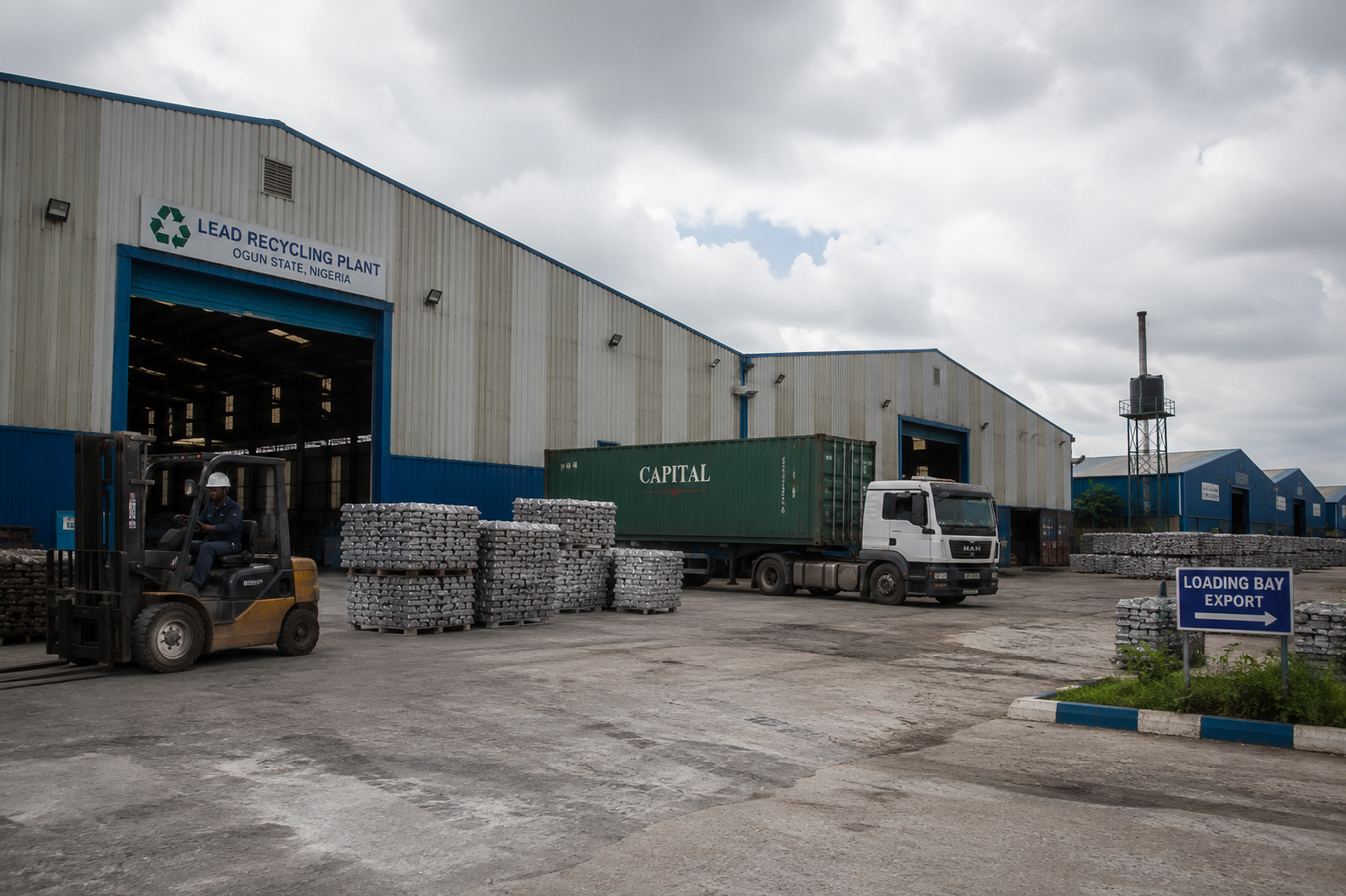
Research by the Institute of Development Studies in the late 2010s described a formal sector built around a single facility: the Ibeto Group's plant in Nnewi, the only operation then meeting international environmentally sound recycling standards, running at roughly 10 percent of its 50,000 to 100,000 tonne capacity because exporters of raw used batteries could outbid it for domestic supply. By 2024, the picture had changed substantially. Field research conducted that September across Lagos, Ibadan, and Abuja identified at least three active manufacturers vertically integrated with recycling operations, and a Germany-backed industry assessment the same year found at least ten facilities recycling batteries at industrial scale, concentrated in Ogun State. NESREA's own 2025 enforcement actions, sealing nine facilities in September and six more in Ogijo in November, independently confirm a formal sector considerably larger than the single-plant picture of a decade ago.
What hasn't grown alongside it is public accounting. No agency publishes what share of the country's lead supply moves through licensed facilities, what share moves through informal collection and smelting, and what share is imported as refined metal. The 2024 field research described the collection layer feeding both channels as fragmented and informal by design; batteries pass through small retailers and scrap aggregators before reaching either a licensed smelter or a backyard operation, and found informal smelting had visibly declined in Lagos as larger recyclers and tighter enforcement absorbed more supply, while conditions outside the city, including northern Nigeria, remain unexamined.
A peer-reviewed material flow analysis of Nigeria's vehicle-derived lead-acid batteries offers the closest thing to a national estimate: of roughly 2.6 million tonnes reaching end of life between 1980 and 2014, approximately 2.3 million tonnes were recycled and 0.3 million tonnes landfilled. That study predates the solar-driven demand this trilogy has tracked, covers vehicle batteries rather than solar batteries specifically, and does not distinguish formally licensed recovery from informal recovery within its recycled total. No source examined for this analysis closes that gap.
What informality costs, wherever it occurs
The evidence is strongest not on how large the informal sector is, but on what unsafe recovery costs, in either sector. The 2025 investigation into Ogijo, conducted with Pure Earth and the University of Ibadan, tested 70 residents living near or working at battery-recycling factories there. Every tested worker showed lead poisoning. More than half the children tested had blood lead levels high enough to cause lasting cognitive harm. Investigators traced recycled lead from named Ogijo facilities, including True Metals Nigeria Limited, through the commodities trader Trafigura to East Penn Manufacturing in Pennsylvania, a supplier to Ford, General Motors, and Tesla.
Formal licensing doesn't, on its own, resolve this. A separate multi-country study of licensed recycling plants across Cameroon, Ghana, Kenya, Mozambique, Nigeria, Tanzania, and Tunisia found that 85 percent of soil samples collected near formally licensed facilities exceeded international lead safety thresholds. This is a distinct exposure pathway from Nigeria's separately documented cases of lead poisoning linked to artisanal gold mining, most notably in Zamfara State. The two shouldn't be conflated: different communities, different industries, different mechanisms of exposure.
Why enforcement hasn't closed the gap
Nigeria's National Environmental (Battery Control) Regulations 2024 require recycling facilities to conduct biannual blood-lead testing of workers and provide protective equipment. NESREA has shown it will act: nine facilities sealed across the south-west in September 2025 for violations including uncontrolled lead dust and improper slag disposal; six more sealed in Ogijo that November, following the Examination and Premium Times investigation; its Director-General warning that licences would be revoked absent verified correction.
Look at when that enforcement happened. Each wave of closures followed external investigative exposure, not routine inspection, a pattern NESREA's own officials have described as a sector that has exhausted the agency's patience rather than one under continuous monitoring.
That timing matters economically. If safe recycling costs meaningfully more than unsafe recycling, and enforcement is triggered mainly by exposure rather than routine inspection, regulation that raises the cost of formal compliance without reliably closing the informal channel risks widening the price gap informal recovery exploits, not narrowing it. Whether that dynamic is occurring at scale, and how it interacts with a formal sector that has grown fivefold in facility count over the past decade, is a question this evidence base can't yet answer. The informal channel's size remains unmeasured.
The absence of data is itself the finding
International Lead Association figures on global recycling rates don't break out Nigeria or West Africa specifically. No agency has published the national accounting, battery sales, domestic production, imports, or formal-to-informal recycling split that the Basel Convention's own technical guidance identifies as the foundation any credible national waste plan requires. Germany's GIZ, through the Partnership for Responsible Battery and Metal Recycling launched in 2024, is working with NESREA and Ogun State to build this monitoring and standards capacity, but that effort remains early.
A market this size, serving one of the continent's largest off-grid solar populations, running without a public account of where its most hazardous input comes from, isn't a data gap incidental to the story, but the story itself. The volume of investigation, enforcement, and international attention Ogijo alone generated in 2025 is itself evidence that the underlying system, formal capacity, informal recovery, import flows, and their relative weight, hasn't been mapped with the rigour its scale and toxicity warrant.
Completing the system view
Three questions now sit next to each other. Why does Nigeria's solar market run on lead-acid batteries: because they are cheaper. What happens when those batteries fail: they enter a recycling system, formal and informal, whose health costs are documented but whose relative scale is not. Where does the lead entering that system originate: the honest answer, at present, is that nobody can say with the precision the question deserves.
None of the three is resolved by answering only one. A market's affordability cannot be judged on purchase price alone if that price doesn't reflect the true cost of the material inside it, and that cost can't be assessed without knowing how much of the supply is recovered safely and how much isn't. Until that accounting exists, "affordable" describes what a household pays, and not what the system costs.