West African Power Pool (WAPP): Progress, Delays and the Road to One Grid
In November 2025, Nigeria's power system operated in real-time synchronisation with the West African regional grid for four consecutive uninterrupted hours. The Nigerian Independent System Operator described it as the first time Nigeria's national electricity network had been operationally unified with the broader West African Power Pool in the system's history. Two months later, on 24 January 2026, NISO was formally admitted to WAPP at the organisation's 20th General Assembly in Lomé, Togo, against the backdrop of three national grid collapses in less than a month.
That combination, a historic regional synchronisation milestone and a recurring national grid failure in the same quarter is a precise description of where West Africa's electricity integration project actually stands in mid-2026: making genuine structural progress toward a unified regional grid while each constituent national system continues to operate with the fragility that makes the regional grid necessary in the first place. The case for integration is built on the evidence of what happens without it. The progress being made is real, but the distance remaining is large and specific.
What WAPP is and what it is trying to do
The West African Power Pool was established by the Economic Community of West African States in 1999 and operationalised in 2006. It covers 14 of ECOWAS's 15 member states: Benin, Burkina Faso, Côte d'Ivoire, The Gambia, Ghana, Guinea, Guinea-Bissau, Liberia, Mali, Niger, Nigeria, Senegal, Sierra Leone, and Togo. Its foundational objective is to create a single unified regional electricity market, the West African Electricity Market, in which power generated in one country can flow freely to where it is needed in another, at a price set by the market rather than by bilateral negotiation, enabling the cheapest available generation to serve demand across the region regardless of which country hosts it.
The economic logic of that objective is straightforward because West Africa's generation resources are unevenly distributed. Nigeria has the largest installed capacity of over 13,000 MW but has never delivered more than 5,801 MW to its national grid due to gas supply constraints, transmission bottlenecks, and operational failures.
Côte d'Ivoire has surplus generation capacity relative to its domestic demand, with a relatively diversified mix of thermal and hydropower, and has been exporting electricity to Guinea and Sierra Leone through the CLSG interconnector since its commissioning. Ghana has the region's highest electricity access rate and a grid that, despite its own reliability challenges, has served as a transit corridor for regional power flows for decades.
Burkina Faso, Mali, Niger, and the Sahel landlocked countries have minimal domestic generation, high electricity costs, and populations whose access to electricity depends almost entirely on either domestic thermal generation running on imported fuel or cross-border flows from coastal neighbours. A unified regional grid would allow the cheapest available generation across all 14 member states to serve the whole region at lower cost than any country can achieve independently.
WAPP's 2030 target is 1,000 MW or more of cross-border electricity trade flowing continuously across the regional interconnected system.
The infrastructure being built: three projects at different stages
The physical architecture of the West African regional grid is being constructed through multiple interconnection projects at different stages of completion. Three merit specific attention because they define the current state of the programme.
The Côte d'Ivoire-Liberia-Sierra Leone-Guinea Interconnector is the most advanced and instructive. The CLSG project constructed 1,303 km of 225 kV transmission line linking four national grids through 11 substations, with a total transfer capacity of 290 MW across two circuits. Construction progressed from 2019, with key segments energised that year and commercial operations launched in December 2021. By 2025, the interconnector was actively exporting electricity from Côte d'Ivoire to Guinea and Sierra Leone, the first reliable cross-border power flows in those corridors in the region's history.
The CLSG project is the evidence of what WAPP's integration ambition looks like when physical infrastructure exists: generation surplus in one country becomes grid-connected supply in another, reducing diesel dependence, lowering electricity costs in recipient markets, and creating a commercial electricity trading relationship between national systems that previously had none.
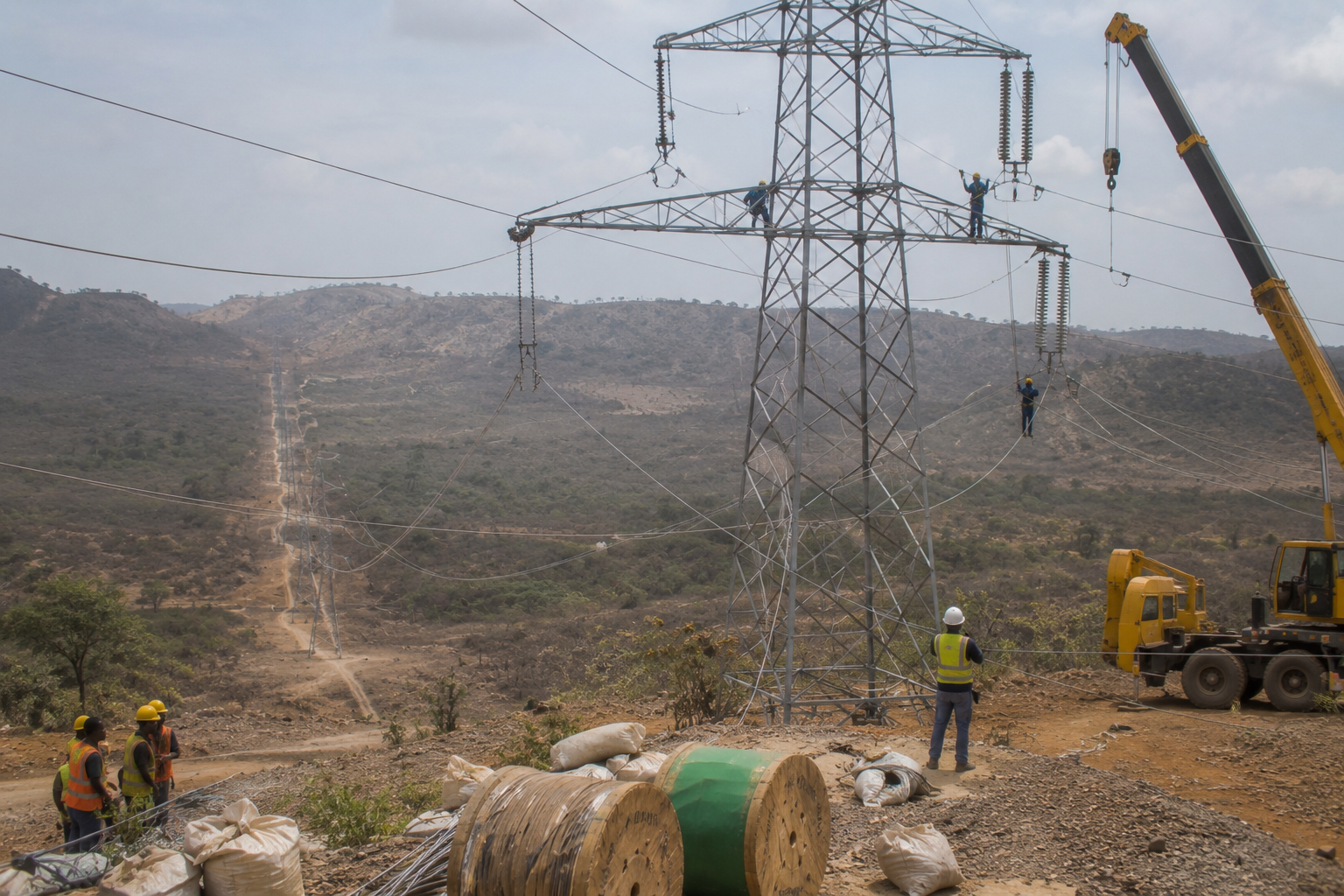
The North Core Interconnection Project is the largest currently under construction and the most strategically significant for landlocked West Africa. The project connects Nigeria at Birnin Kebbi to Burkina Faso at Ouagadougou through 875 km of 330 kV transmission line, passing through Zabori, Niamey, and Gorou Banda in Niger, with a branch line to Malanville in Benin.
Five substations are being constructed along the route: Birnin Kebbi in Nigeria, Zabori and Gorou Banda in Niger, Ouaga East and Ouaga South-East in Burkina Faso, and Malanville in Benin. When complete, the project will enable Nigeria to export electricity into the landlocked Sahel countries, Niger, Burkina Faso, and Mali, which currently depend almost entirely on isolated national grids running on expensive imported fuel.
As of 31 December 2025, the North Core Project had reached 56 percent overall physical completion. Of the 880 km of transmission corridor, 728.7 km had been cleared, and 5,692 project-affected persons had been compensated. The project's original completion target was 2023. It was revised to 2026.
At 56 percent physical completion in early 2026, with security challenges and logistical constraints acknowledged as active factors in the project's April 2026 Joint Supervision Committee report, the 2026 completion target is no longer credible. The WAPP Secretary General's representative at that meeting said, "while steady progress has been recorded, security challenges and logistical constraints in parts of the region continue to delay timelines and raise costs."
The security dimension is real; the North Core's transmission corridor passes through Niger and Burkina Faso, two of the three Sahel states that experienced military coups between 2021 and 2023 and that have since experienced significant deterioration in security conditions in their northern and central regions. Constructing 875 km of high-voltage transmission infrastructure through those corridors requires access, logistics, and contractor safety conditions that the security environment has made intermittently unavailable. The project is being built despite those conditions, but not at the pace those conditions make unimpeded.
The Ghana-Côte d'Ivoire Reinforcement Project addresses a different constraint: adequacy of capacity on an existing interconnection rather than the absence of one. The first interconnection between Ghana and Côte d'Ivoire was built in 1983. Feasibility studies for a second, reinforced line began in 2011, and a World Bank facility for the project was secured in 2022.
In June 2025, Ghana's GRIDCo and Côte d'Ivoire's CI-Energies signed a Memorandum of Understanding for a 125 km 330 kV double circuit transmission line from Elubo on the Ghana border to Bingerville in Côte d'Ivoire, financed at €154 million through the World Bank. Construction implementation is expected to begin in 2026. Completion is projected for 2029. The project illustrates a dynamic that the continental transmission gap discussion doesn't often feature: the bottleneck is sometimes not the absence of any interconnection but the inadequacy of the interconnection that exists. A single circuit line built in 1983 cannot carry the volumes of power that a functioning regional electricity market between Ghana and Côte d'Ivoire would require.
The synchronisation challenge: harder than the infrastructure
Physical transmission infrastructure moves electrons between countries. Synchronisation moves national electricity systems, each with its own frequency characteristics, operational standards, and institutional culture, onto a single, coordinated platform, where a fault in one country does not cascade to its neighbours.
The November 2025 synchronisation of Nigeria's grid with WAPP for four consecutive hours was a test. Phase 2, targeted for June 2026, is designed to convert that test into a continuous operational reality, moving West Africa's national grids from loosely coupled bilateral exchanges to a unified system in which power flows in real time across borders under shared management.
That transition requires, as NISO's Executive Director Nafisatu Ali stated at the April 2026 Osogbo session, strict adherence to unified operational standards: frequency control, voltage stability, spinning reserve adequacy, and contingency management. These are the same requirements ETA has documented as deficient within individual national systems: free governor control that required a formal NERC enforcement order to activate, protection coordination still presenting "deeper structural issues," and a USD 56 million SCADA system not yet fully operational.
The synchronisation challenge, stated plainly: you cannot synchronise systems that cannot individually maintain the standards synchronisation requires. The June 2026 milestone is a credible next step. A continuously operating unified regional grid remains a programme whose outcome depends on national operational capacity still being built.
What success looks like and what it would mean
Burkina Faso, Mali, and Niger pay among the highest electricity tariffs in West Africa for the least reliable supply, because their generation depends on isolated systems burning expensive imported fuel. Regional power trade at scale would reduce those costs by connecting them to lower-cost surplus generation from coastal states, converting the North Core from infrastructure into an economic instrument.
The CLSG interconnector is already demonstrating this logic. Côte d'Ivoire exports power to Guinea, Liberia, and Sierra Leone, monetising surplus capacity that would otherwise be curtailed. Ghana has drawn on Ivorian power during domestic shortfalls to avoid deeper load shedding. This is what WAPP's vision looks like when the physical infrastructure exists.
Nigeria's potential contribution is the largest in absolute terms, but contingent on first achieving reliable domestic dispatch, which the collapse record of 2024 and early 2026 makes clear is unresolved. The WAPP integration story and Nigeria's domestic grid story are the same story at different scales.
WAPP's 2030 target of 1,000 MW of continuous cross-border trade requires completed infrastructure and the operational human systems to manage regional dispatch in real time. The June 2026 Phase 2 milestone is the next logical step toward both.