Africa's Internet Runs on Fibre. The Power Keeping It Online Still Runs on Diesel.
In November 2025, Meta and its partners announced the completion of the core infrastructure of 2Africa, the most ambitious submarine telecommunications system yet built on the continent. The cable is designed to extend roughly 45,000 kilometres, connect 33 countries through dozens of landing points, and, on its West trunk, support capacity of up to 180 terabits per second, reaching Africa, Europe, and the Middle East, with South Asia added through the Pearls extension scheduled for 2026.
The engineering is extraordinary, but the resilience of Africa's digital economy depends on more than what lies beneath the ocean. Once fibre reaches land, data must pass through cable landing stations, terrestrial fibre networks, data centres, and hundreds of thousands of mobile base stations before reaching a phone, bank terminal, or business, and every one of those layers requires reliable electricity. Across much of Africa, the electricity system beneath the digital system is still heavily dependent on diesel.
CrossBoundary Energy estimates that roughly 70% of Africa's approximately 500,000 telecommunications towers rely on diesel power. In remote areas, energy can account for 30 to 60% of tower operating expenditure, and between 60% and 80% of telecom towers in sub-Saharan Africa experience eight to twelve hours of grid outages each day. That is one of the least discussed contradictions in Africa's digital transformation: the continent is building twenty-first-century communications infrastructure on top of an electricity system that often requires generators and fuel trucks to keep it functioning.
The cable is only the beginning
Submarine fibre is easy to imagine as passive infrastructure, strands of glass carrying pulses of light beneath the ocean, but the physical system is more complicated. Long-distance cables contain repeaters that amplify signals along the route, and cable landing stations connect those systems to terrestrial networks, housing power-feeding, transmission, cooling, and communications equipment designed with redundant electricity systems, because a loss of power at the wrong point can interrupt international connectivity. Equinix describes backup power as a fundamental element of modern cable landing stations, and an earlier African Development Bank environmental assessment for the MainOne submarine system described the arrangement envisaged for its West African landing facilities as national-grid electricity supplemented by diesel-powered backup generators.
That doesn't mean every African cable landing station today is powered primarily by diesel; some sit in stronger grids, have diversified backup systems, and operators generally disclose little station-level energy data. It does mean diesel has long been part of the reliability architecture protecting critical fibre infrastructure from unstable power systems. The larger dependency becomes far easier to quantify once the internet leaves the landing station.
Half a million towers expose the scale
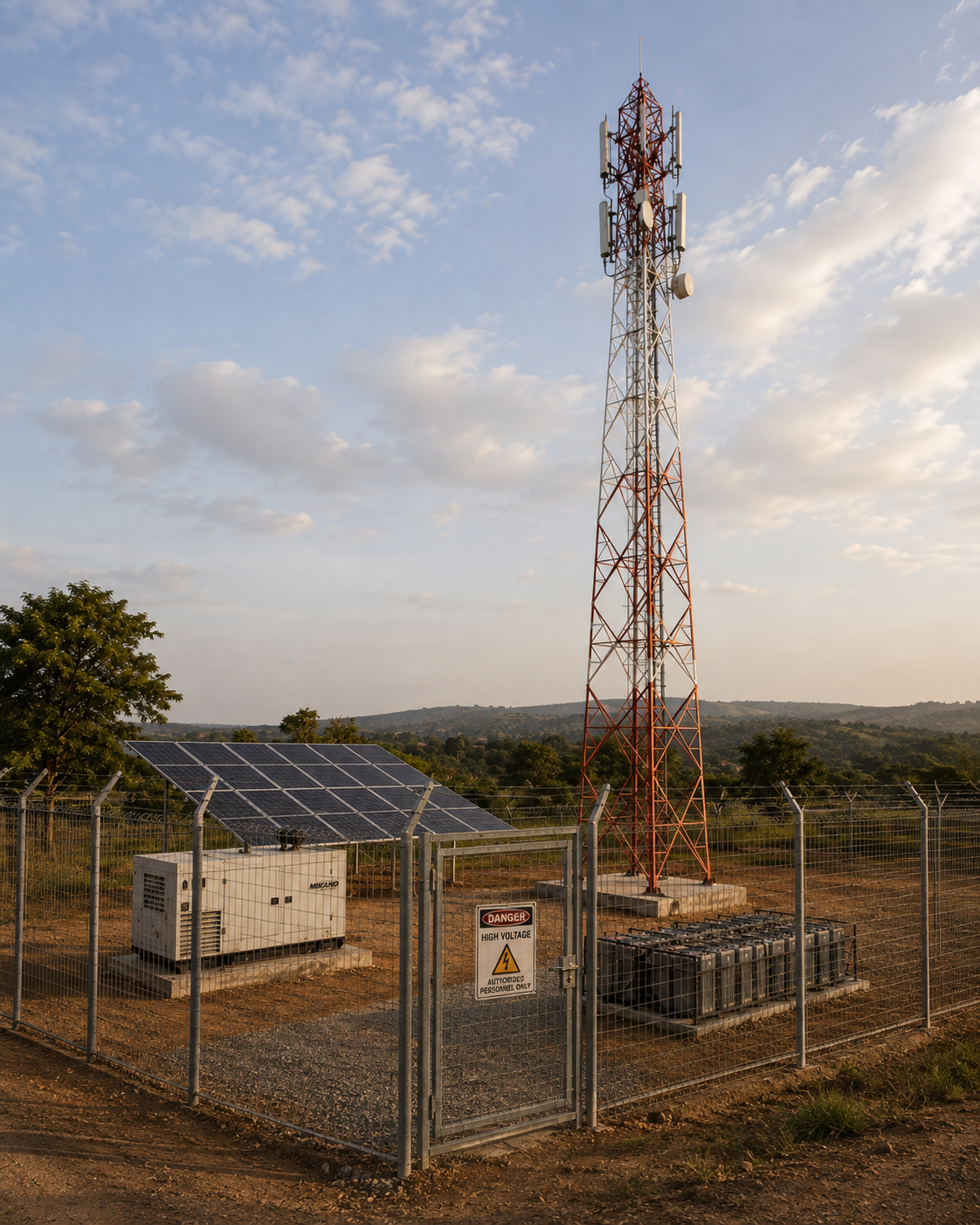
Africa's mobile internet economy runs on roughly 500,000 towers, about 70% of them diesel-dependent according to CrossBoundary Energy. In off-grid and weak-grid markets, generators aren't emergency equipment; they may run for many hours daily, because a base station cannot stop serving customers every time the grid fails. CrossBoundary reports 60 to 80% of sub-Saharan towers experience eight to twelve hours of daily outages, with Nigeria among the starkest cases, where grid availability in some areas is estimated at only 40 to 50%. Operators build their own miniature energy systems around each tower: a grid connection where available, batteries to bridge gaps, a generator for longer outages, and diesel delivered by road. At continental scale, this makes telecommunications partly an energy-logistics business.
The economics are usually described in terms of fuel price, which understates the problem. Diesel must be purchased, transported, stored securely, and delivered to thousands of dispersed sites, some reachable only over poor roads. CrossBoundary, citing GSMA intelligence, estimates fuel transport alone adds 15 to 30% to tower operating costs, with total energy expenditure reaching 30 to 60% of costs in remote areas. Delayed trucks, theft, poor roads, and volatile oil prices all become telecommunications risks.
In May 2026, the Associated Press reported rising diesel costs were adding urgency to the shift towards solar; Vodacom said its group energy costs had risen about 5% to $300 million in 2025. Diesel solves one infrastructure weakness by creating another: it protects a tower from an unreliable grid while exposing it to global oil prices and fuel logistics.
Why diesel remains difficult to replace, and where it is already being replaced
The obvious question is why operators keep using a fuel that is expensive, volatile, and carbon-intensive when Africa has some of the world's strongest solar resources. The answer is less about technology than reliability and capital. A diesel generator is dispatchable: if fuel is available and the machine is maintained, it produces power whenever required. A solar system must be designed around load, irradiation, batteries, and required autonomy, and existing towers may need retrofits, with capital committed upfront, requirements that can slow deployment even where lifetime economics favour renewables.
Energy-service companies are changing that equation: a third party finances, installs, and operates solar and batteries while the telecoms company simply buys the electricity, an arrangement it estimates can save 20 to 40% over fossil-based alternatives. Atlas Tower Kenya had, by May 2026, solarised 82% of its roughly 500 existing towers, according to AP reporting, and is investing a further $52.5 million to build 300 more with solar central to the design. CrossBoundary has built similar systems in Sierra Leone, South Sudan, and the DRC. The model is rarely solar alone; it is usually solar plus batteries, sometimes with a smaller diesel generator kept for extended backup. The goal isn't necessarily removing every generator immediately, but reducing how often it runs, and a tower burning diesel two hours a month has a fundamentally different profile from one burning it eight or twelve hours a day.
The 2024 cable outage showed a different kind of dependency
Power reliability is only one part of digital resilience. On 13 to 14 March 2024, four major submarine systems off West Africa, ACE, SAT-3, WACS, and MainOne, were disrupted following a suspected fault near Côte d'Ivoire. The Internet Society's assessment found that the outage affected 13 countries, with impacts ranging from near-total outages to degraded service. Operators with access to alternative submarine systems could reroute traffic, and Google's Equiano cable, which bypassed the damaged route, became particularly important, with traffic reportedly increasing fourfold. Niger, still reliant on satellite in places, maintained uptime by routing over terrestrial fibre via Burkina Faso into Benin.
The lesson was that digital infrastructure functions as a chain: submarine cables need alternative submarine cables, landing stations need resilient backhaul, terrestrial networks need multiple routes, and every link still needs power. A country can have 180 terabits per second offshore and still suffer poor connectivity inland if its terrestrial fibre, towers, and electricity infrastructure are weak.
More bandwidth means more electricity demand, not less
The scale of 2Africa shows how fast the communications side of this is changing. But more bandwidth generates more traffic, and more traffic means more equipment, tower densification, and data centres. CrossBoundary estimates 5G can require substantially higher tower density and energy use even as it becomes more efficient per unit of data, so the energy challenge could deepen unless power investment moves with it. Africa isn't simply connecting more people; it is building an increasingly electricity-intensive digital economy, which is why digital policy and energy policy, historically separate conversations, can no longer stay that way. Where the grid fails, operators build parallel systems around diesel; where fuel becomes expensive, communications costs are exposed; where renewables require capital tower companies cannot provide upfront, financial innovation becomes telecoms policy.
Replacing diesel at telecoms sites isn't simply an emissions initiative. It is an infrastructure-resilience strategy: a solar-battery tower reduces fuel imports, lowers costs, insulates networks from oil-price shocks, and extends connectivity where grid expansion may take years. That transition is already under way in Kenya and elsewhere. But with roughly 500,000 towers continent-wide and an estimated 70% still relying on diesel to some degree, the installed base remains enormous, and fibre travelling at the speed of light inland still depends, in most places, on a tower that may be running on fuel delivered by truck.