Africa Has $29.5 Trillion in Mineral Wealth. It Captures Almost None of What Those Minerals Are Worth.
Africa's critical minerals now feature in almost every significant conversation about the global energy transition. The continent holds approximately 92 percent of global platinum reserves, 56 percent of cobalt reserves, 54 per cent of manganese reserves, and 36 percent of chromium reserves. According to the African Finance Corporation, Africa's total mineral wealth is estimated at roughly $29.5 trillion. These figures appear in speeches, investment forums, G7 preparatory documents, and climate summits with increasing regularity.
And yet Africa captures only a small fraction of the economic value generated from those minerals.
The explanation most commonly offered is corruption, governance failure, weak institutions, and unfair trade, which describe symptoms rather than the structural mechanisms producing them. This piece explains that mechanism precisely: where value is created across the critical minerals chain, at which stages prices multiply, why Africa is largely absent from those stages, and what would actually need to change for that to be different.
The four stages where value accumulates
The critical minerals economy operates across four sequential stages. Understanding where value accumulates at each stage is the starting point for understanding why the headline wealth figures and the actual development outcomes diverge so sharply.
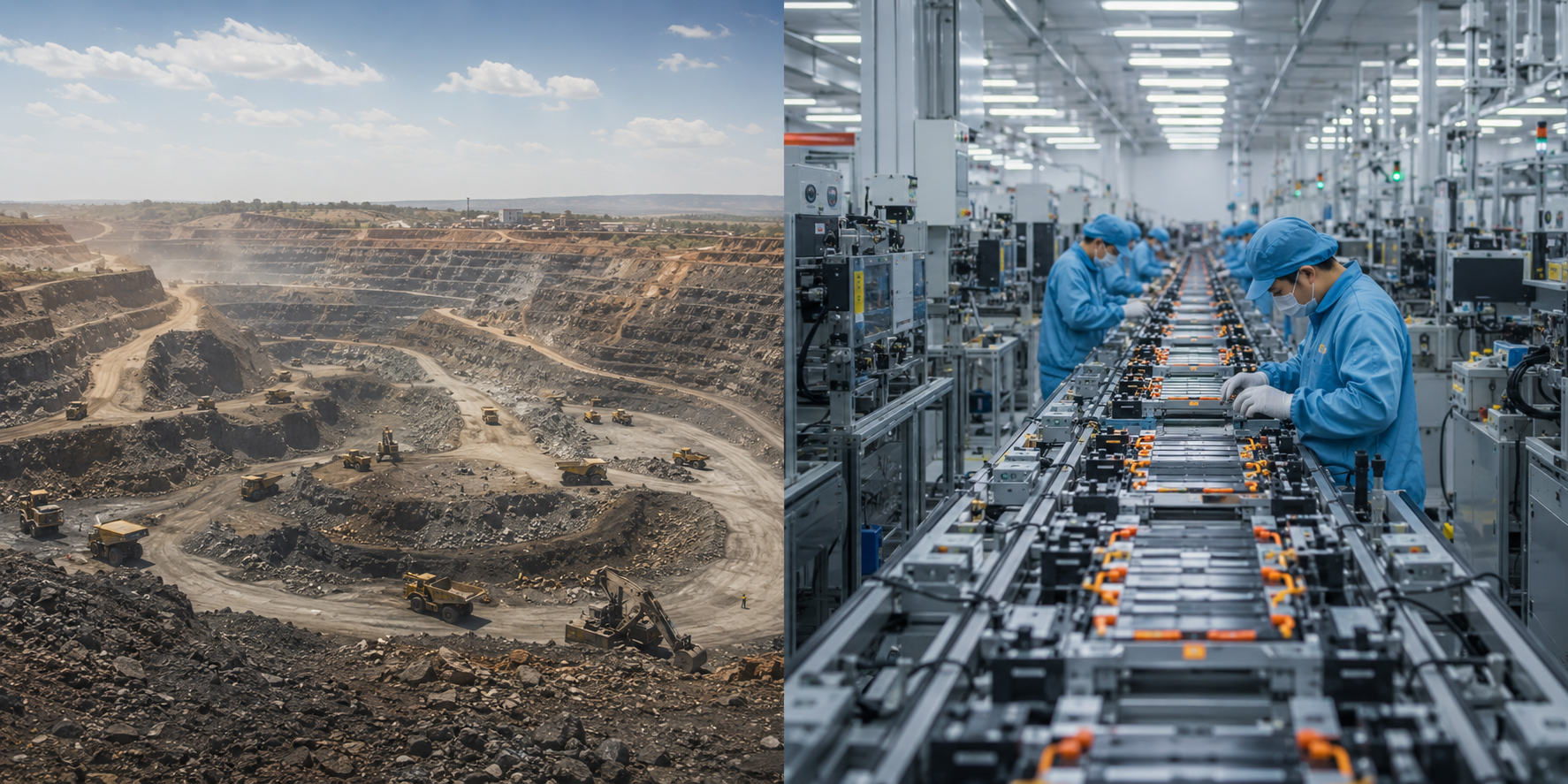
The first stage is extraction. This is the stage Africa already participates in most heavily. Minerals are mined, concentrated, and exported in relatively raw form: cobalt ore, lithium concentrate, manganese, platinum group metals, and graphite. At this point, the commodity has genuine value, but it is the lowest-margin point in the chain. Extraction is capital-intensive and operationally complex, but the price the market assigns to raw or minimally processed mineral output reflects that processing, refining, and manufacturing still lie ahead. This is also, critically, the stage at which most African countries exit the supply chain system.
The second stage is processing and refining. This is where value begins multiplying rapidly. Lithium concentrate becomes lithium hydroxide or lithium sulphate. Cobalt ore becomes battery-grade refined cobalt. Graphite is purified and shaped into battery anode material. Manganese is processed into the high-purity compounds required for battery cathodes. As ETA has previously documented, drawing on cobalt chain data, cobalt extracted at the mine stage may generate approximately $5.8 per kilogram; after refining and processing, that figure can reach $16.2 per kilogram or more, depending on the downstream processing stage. The multiplication is structural. It is the economic reason that beneficiation, the processing of raw materials closer to their point of extraction, is treated as a priority in African development policy. But processing infrastructure is expensive. Refineries, chemical plants, industrial power systems, logistics infrastructure, water treatment systems, and specialised engineering capacity all require substantial capital investment before a single tonne of battery-grade material is produced.
The third stage is manufacturing. This is where processed minerals become industrial components: battery cells, cathodes, electric vehicle drive systems, electronics, and renewable energy hardware. At this stage, value multiplication accelerates again. And this stage is overwhelmingly concentrated outside Africa: in China, which dominates battery cell manufacturing and controls the refining of most transition minerals; in South Korea and Japan, which are central to battery technology and advanced manufacturing; and in Europe and North America, which are building competitive manufacturing capacity rapidly. Manufacturing ecosystems are not simply capital investments. They depend on industrial clusters, technology ownership, patents, skilled labour accumulated over decades, logistics integration, and deep financing systems that function at low cost over long investment horizons. A processing plant can be built in a new location if capital is available. A manufacturing ecosystem takes considerably longer to construct, and it requires every element of the supply chain to function coherently around it.
The fourth stage is end products: electric vehicles, battery storage systems, smartphones, renewable energy infrastructure, and the advanced industrial goods that global markets purchase at the highest price points. Africa's participation at this stage is minimal relative to the value generated from its raw materials. By the time cobalt extracted in the Democratic Republic of Congo has moved through Chinese processing, South Korean battery cell manufacturing, and a German or American electric vehicle assembly line, the value it contributes to the final product bears little relationship to the royalties, taxes, and wages it generated at extraction.
Why Africa exits the chain at stage one
The explanation most frequently offered for Africa's low value capture, governance failure, corruption, and weak institutions isn't wrong, but it is incomplete. It describes conditions that affect the terms on which extraction happens. It doesn't explain why processing, manufacturing, and end-product assembly are absent from the continent at scale.
The mechanism that explains the absence operates at the financing level rather than the governance level.
Processing infrastructure requires large-scale industrial financing at competitive cost over long investment horizons. A lithium hydroxide refinery isn't a small capital commitment. A battery precursor manufacturing facility isn't the kind of investment that pays back in three years. The financing structures required to build these assets, low-cost long-tenor debt, patient equity, blended concessional capital, are systematically more expensive in African markets than in the markets where competing processing capacity already exists.
As ETA has previously documented, drawing on World Economic Forum and academic research, renewable energy developers and industrial infrastructure investors across several African markets frequently face weighted average financing costs of between 15 and 18 percent, compared with approximately 2 to 5 percent in many advanced economies. That differential isn't a small technical disadvantage. It is the primary mechanism that makes processing economically unviable in African markets relative to markets where equivalent infrastructure already exists and where financing costs are a fraction of African levels.
UNCTAD estimates that the Global South faces approximately $225 billion in investment shortfalls concentrated heavily in downstream mineral processing and industrial activities. That gap isn't evenly distributed. It is concentrated precisely at the stages where value multiplication is highest: refining, chemical conversion, advanced processing, and manufacturing integration. The mine exists where the geology is. The processor goes where capital is cheapest and industrial systems are most mature.
What the Zimbabwe case demonstrates
The clearest recent illustration of this mechanism in practice is Zimbabwe's lithium export ban, in force since 2022. The policy logic was direct: stop exporting unprocessed ore, create incentives for local processing investment, and capture more value domestically. In early 2026, Huayou Cobalt commissioned a $400 million lithium sulphate plant at the Arcadia Mine, Africa's first facility of its kind. Processing had moved onto African soil.
But ownership had not. The refinery is a Chinese company's asset, integrated into Chinese battery supply chains, and connected primarily to downstream manufacturing systems outside Zimbabwe. Zimbabwe's position in the value chain improved relative to raw ore exports, which is a real and meaningful gain. But the broader value chain architecture remained substantially external. The export ban successfully relocated processing geographically. It did not automatically relocate ownership, financing, technology, or industrial control.
This is precisely the distinction the $225 billion UNCTAD financing gap explains. If domestic or regional capital is unavailable at sufficient scale and competitive cost, foreign firms will fill the processing investment gap on their own terms. The processor arrives. The value chain does not follow.
Why the policy conversation needs to be more precise
The Nairobi Declaration from the Africa Forward Summit in May 2026 committed governments to sovereignty over natural resources, local beneficiation, value addition, and technology transfer on fair terms. That language reflects a genuine and growing African understanding that extraction alone will not generate the economic transformation the mineral endowment could theoretically support.
Three weeks after Nairobi, the G7 summit in Évian will discuss strategic stockpiling, critical minerals coordination, supply chain security, and industrial resilience from the consuming economy's perspective. Both rooms are discussing the same supply chain from opposite ends of it.
The mechanism that determines who captures the value sits between those two conversations. It is not resolved by declarations of sovereignty, and it is not determined solely by the preferences of consuming economies. It is determined by who finances the processors, who owns the refining systems, who controls the manufacturing ecosystems, and who captures the multiplication in price after extraction ends.
Export restrictions are one tool in that negotiation. The African Union's Continental Critical Minerals Value Addition Framework, adopted in February 2026, attempts to build the broader industrial policy architecture that export bans alone cannot create. Equity participation requirements, technology transfer provisions, local procurement systems, and industrial financing strategies are all components of the framework that export restrictions can open the door to, but cannot complete on their own.
The $29.5 trillion in mineral wealth is real. So is the gap between that figure and what African economies actually receive. Closing that gap requires the precise understanding of where value accumulates and why, not the approximate framing that governance improvement and export bans are sufficient answers to a problem that is fundamentally about industrial financing architecture.
Because the energy transition economy's greatest value is not created where minerals are extracted from the ground. It is created where they are transformed, and who controls that transformation is the question Africa's mineral policy must answer precisely.