South Africa Cuts Power Prices for Smelters. Who Pays?
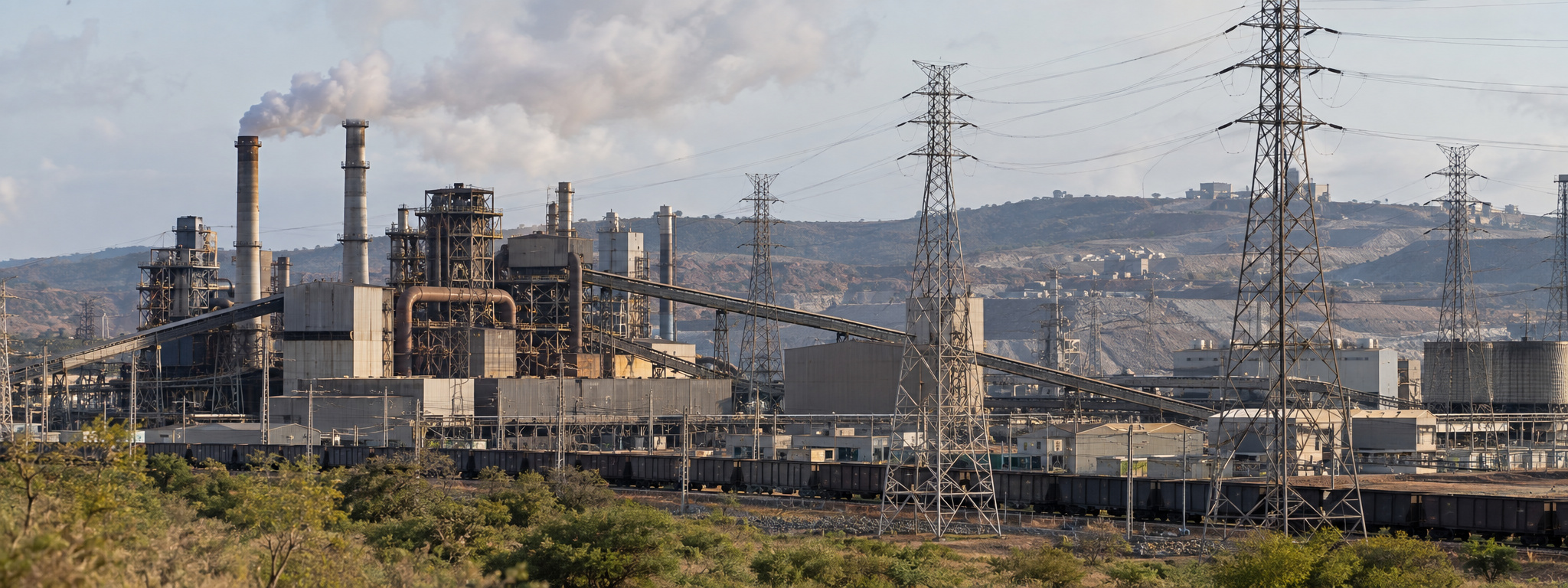
On 29 May 2026, South Africa's energy regulator approved a 62c/kWh tariff for the Samancor Chrome and Glencore-Merafe ferrochrome smelters, effective from 1 June, alongside an undisclosed negotiated rate for the Manganese Metal Company. In the same financial year, Eskom's industrial sales fell 22.5 percent and total sales dropped from 189.7 terawatt-hours to 178.0 terawatt-hours, a decline the utility has recorded, in some form, for more than a decade a
gainst a peak above 224 terawatt-hours in 2012. The discount exists to win back load that is leaving the grid. South Africa's draft pricing policy now proposes to make this kind of discount a standard instrument, available well beyond the smelters currently in distress. That is the tension this piece works through.
What the policy promises, and to whom
The Department of Electricity and Energy published its draft Revised Electricity Pricing Policy in Government Gazette No. 55257 on 28 August 2026, the first substantive revision since the original 2008 policy, opening a comment period that closed in late September. The draft does three things simultaneously.
It commits all regulated tariffs to becoming cost-reflective within five years, a principle meant to ensure Eskom recovers its full costs, including a reasonable margin, while still obtaining reasonably priced financing on a forward-looking basis. It formalises Negotiated Pricing Agreements as standing incentive pricing for priority industrial sectors, allowing them to operate competitively, retain capacity and attract investment, rather than treating each discount as an emergency measure negotiated case by case. And it retains Free Basic Electricity and lifeline tariffs for poor households, with the minister separately proposing to raise the free monthly allocation from 50 kilowatt-hours toward 200 to 300, without expanding the existing R21 billion annual budget for the programme.
That third commitment needs a qualification the department's briefing does not volunteer. The proposed increase sits in a separate policy governing Free Basic Electricity, not inside the pricing policy itself, and the draft creates only an annual decision process involving two government departments and the Treasury, not a guaranteed allocation. It should be read here as a ministerial proposal, not a settled policy provision, a distinction that shapes everything that follows.
The policy's actual design is defensible
The draft's strongest feature complicates the simple story that captive customers are left holding the bill. Its policy positions place a regulated legacy recovery charge and a subsidy charge inside the wholesale tariff structure, bar any transmission-connected customer from avoiding approved subsidies or legacy costs unless the regulator grants an exception, and state explicitly that no customer using wheeled power is subsidised by one who is not, and that wheeling customers cannot escape cross-subsidy contributions either. A separate generation standby charge applies even to customers running self-generation, provided they remain connected to the network.
One exclusion is more consequential than it first appears. Private generation used entirely behind the meter, for the generator's consumption and never conveyed over public networks, sits outside the policy's scope altogether. Eskom's 2026 financial statements cite the surge in behind-the-meter solar as one contributor to falling sales. The real question this design raises is therefore not whether large users can dodge subsidy charges on the network, since the draft is genuinely built to prevent that. It is whether the network base those charges are levied against remains large enough to carry them.
The base carrying these charges is shrinking
Eskom's annual financial statements for the year to 31 March 2026 show sales falling from 189.7 to 178.0 terawatt-hours, a decline of just over 6 percent, driven by smelter curtailments, mining shutdowns, an ongoing surge in solar installations and demand that has not recovered as hoped. Industrial sales alone fell 9.7 terawatt-hours, or 22.5 percent, concentrated in the country's remaining ferrochrome producers. Gross municipal arrears reached R111.6 billion at year-end, climbing to roughly R119 billion by June, with Eskom itself projecting a rise toward R358 billion by 2031 without intervention.
Municipalities resell electricity to fund other services, and Statistics South Africa's most recent detailed data put municipal electricity sales at R118.1 billion against purchases of R95.1 billion in 2020/21, a surplus of roughly R23 billion the OECD estimates can represent 25 to 30 percent of municipal income, though the share varies enormously between areas. Reporting on Eskom's results has already flagged the mechanism this combination points toward: rising tariffs used to cover a shrinking sales base risk driving further customers toward self-generation, a pattern some coverage has described plainly as a utility death spiral.
Eskom maintains the ferrochrome agreements will not raise tariffs for its wider customer base, require fresh borrowing or need further government support, arguing the deals monetise 2 to 3 gigawatts of surplus capacity that covers variable costs and still contributes toward fixed costs it carries regardless under long-term coal contracts. That defence is a genuine argument, not a dismissal to be waved aside, and it holds for as long as the surplus itself persists, no longer.
Where the policy leaves questions unanswered
The public record reviewed for this piece leaves three specific funding questions unanswered rather than merely unclear. The gazette's section on Negotiated Pricing Agreement revenue treatment proposes what reporting describes only as "explicit handling" of the impact on other revenue, without stating whether Eskom, the fiscus or the subsidy charge itself absorbs a shortfall if one occurs. The Free Basic Electricity gap is a delivery problem as much as a funding one: Eskom's estimate puts roughly 10 million households as eligible, against only about 2 million who actually receive the benefit, meaning the entitlement itself is currently a funding variable regardless of what the final allocation is set at. And the department's parallel market transformation paper limits early participation in a more open market to users above a threshold it has not yet set, offering one megawatt only as an illustrative figure and describing every user below it, for now, as captive.
The Portfolio Committee on Electricity and Energy stated this clearly after its briefing on 22 September, noting the policy explains a great deal about the tariff and considerably less about what an ordinary household will actually pay, since the bill's structure is changing alongside its level: consumers could face separate energy, capacity, network, distribution and service charges layered against subsidies, legacy costs and municipal surcharges, with the department itself confirming it has not set a specific final retail price the policy guarantees.
What this means, and what to watch
South Africa is attempting to use tariff design to keep energy-intensive industry connected to the grid while simultaneously widening social protection, and the instinct behind making subsidies visible and non-bypassable is a sound one. What remains unresolved is the size of the bill this creates and who is actually funding it, in a system where the sales base those charges depend on keeps shrinking. Committee members raised a more fundamental version of the same worry: the original legislation establishing Eskom envisaged electricity as an affordable, subsidised utility for industrialisation rather than a commodity for trading, a framing several members argued the shift toward cost-reflectivity risks abandoning just as the country needs cheap, reliable power to compete for industrial investment rather than simply to balance a budget.
The pattern is not unique to South Africa. Negotiated exceptions to standard tariff rules are becoming a common tool for keeping energy-intensive industry viable across the continent, a dynamic ETA has traced in Zambia's copper-anchored electricity market, where mining demand has similarly become the anchor around which the rest of the pricing structure is built. Whether the final South African text quantifies the revenue impact of its industrial discounts, whether Treasury ring-fences funding for the free electricity increase rather than leaving it to annual negotiation, where the market-participation threshold finally gets set, and whether the regulator ever publishes the size of the subsidy charge, are the four developments that will determine who ends up paying for a policy that, for now, lists its subsidies without identifying their funders.