Who Will Finance the Power Behind Africa's Digital Economy?
On 1 September 2026, in Riyadh, Africa Finance Corporation and Saudi Arabia's Vision Invest agreed to inject a combined $300 million into WIOCC Group, the pan-African operator whose assets span terrestrial fibre, submarine cables and data centres. The capital was earmarked for expanding and consolidating data-centre capacity, extending terrestrial fibre into new markets, and adding subsea infrastructure. There was one infrastructure category the announcement did not separately finance. No dedicated power plant, battery portfolio, or transmission programme sized to the new load.
That does not mean WIOCC has ignored energy entirely; its Open Access Data Centres subsidiary has already begun investing in solar, but those investments sit alongside the digital programme rather than inside the $300 million transaction itself. What the deal reveals is structural: Africa has become genuinely good at financing the infrastructure that carries and processes data. The electricity infrastructure that keeps that system alive is still usually financed through a separate transaction, on a separate timetable, by different investors.
The digital capital is real, and it is already substantial
WIOCC says it has invested roughly $950 million in digital infrastructure assets to date, including more than 115,000 kilometres of terrestrial fibre and extensive submarine capacity, and the new investment is meant to push that footprint further as demand from cloud computing, AI and content delivery accelerates faster than the infrastructure available to support it. Only 35.7 percent of Africans used the internet in 2025 against a 73.6 percent global average, the gap this capital is meant to close.
IFC has separately been financing the same expansion from the debt side: in May 2026 it provided a $20.8 million sustainability-linked loan to WIOCC subsidiaries, part of a broader roughly $577 million expansion programme covering new fibre, data-centre capacity in Nigeria, South Africa and the DRC, and fibre-to-premises expansion in Nigeria. This is infrastructure finance behaving exactly as it should: investors identify a growing market, contracts support revenue projections, and capital is aggregated through a platform that builds multiple assets across countries. The question is what happens one layer below, because a data centre isn't simply a building connected to fibre, but an electricity consumer that happens to process data.
A data centre can be built in three years. The grid rarely moves that fast.
Optical fibre itself consumes little electricity along much of a terrestrial route; the network built around it does. Submarine systems need powered repeaters and landing facilities, terrestrial networks depend on routers and switching equipment, and mobile networks add radio equipment across hundreds of thousands of base stations. At the end of the chain sit data centres, where servers run continuously and cooling, backup power and network equipment add further load.
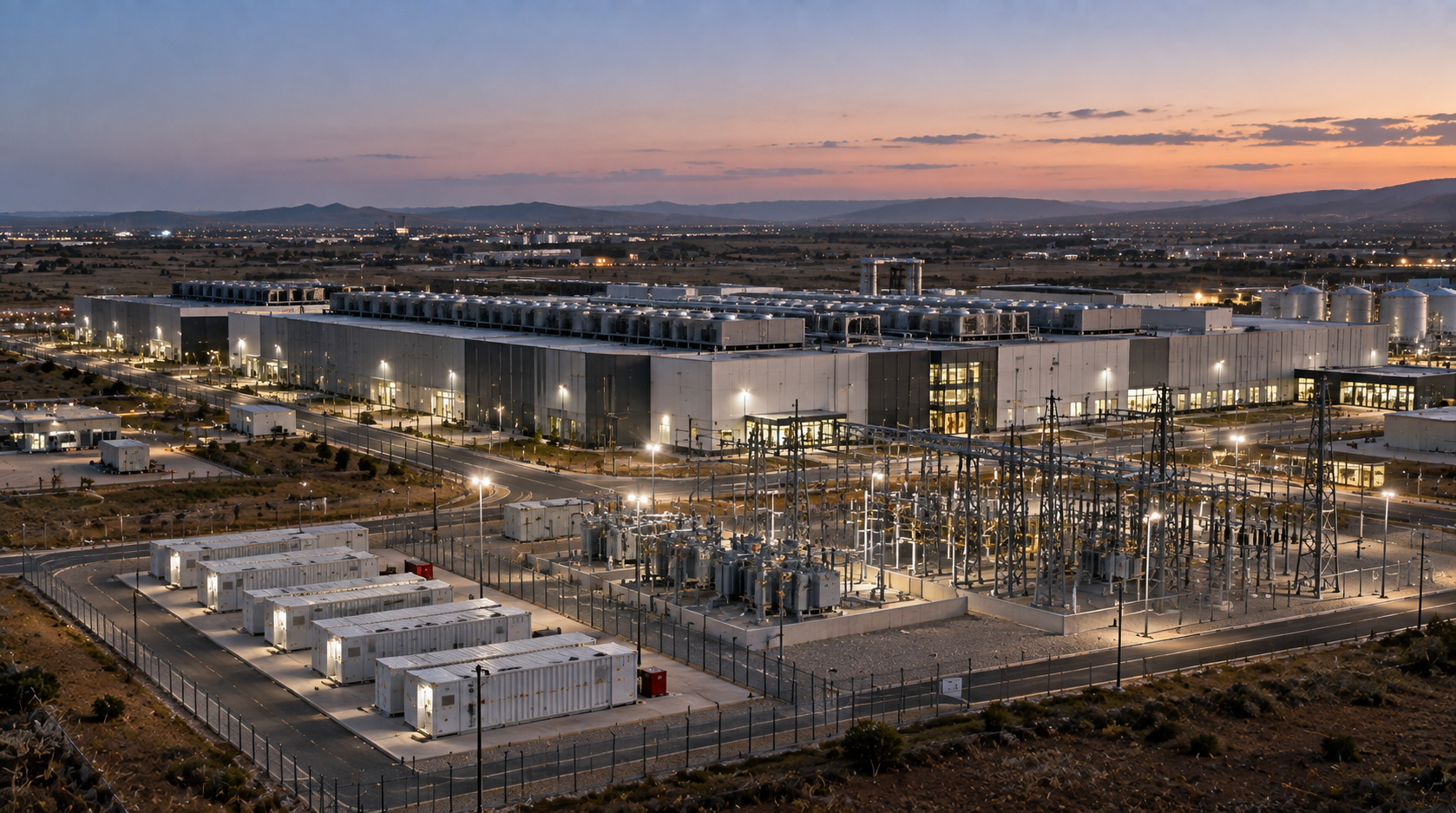
The IEA expects global data-centre electricity consumption to rise from roughly 485 terawatt-hours in 2025 to about 950 terawatt-hours by 2030, with AI-focused facilities tripling their consumption over that period, and the agency has flagged a specific timing mismatch behind that growth: a data centre can often be developed in two to three years, while the electricity infrastructure it needs typically has longer lead times, a gap the IEA estimates could delay a fifth of planned global data-centre projects. In stronger grids, that complexity gets absorbed without much visible strain. In weaker African markets, the investor ends up rebuilding part of the electricity system itself, which is where diesel, captive gas plants and private power purchase agreements enter.
Telecom towers already showed what happens when power finance arrives late
The physical scale hidden behind a phrase like "30 megawatts of reliable renewable electricity" became concrete in August 2026, when CrossBoundary Energy brought online a solar-and-battery facility at the Kamoa-Kakula copper complex in the DRC, Africa's largest copper mining operation. To guarantee the mine 30 megawatts of firm baseload power at 95 percent annual availability, the system uses 233 megawatts of solar capacity paired with 526 megawatt-hours of battery storage, a ratio of nearly 7.8 megawatts of installed solar for every megawatt of contracted firm output.
That ratio should not be applied mechanically to a data centre, since solar resource and reliability requirements vary by project. Still, it shows the order of magnitude: 30 megawatts of continuous clean power is not a 30-megawatt generation project. It can require hundreds of megawatts of variable generation and a large storage system behind it, the energy asset sitting largely invisible behind any digital-infrastructure headline.
Four models are already emerging, and they point in different directions
The market is not waiting for a single elegant solution, and four distinct financing patterns are visible already. The first is self-financing by the digital operator directly. Teraco, South Africa's largest data-centre provider, secured grid capacity allocation from Eskom and began building its own 120-megawatt solar plant in the Free State, financed through a green loan and wheeled to its facilities in Johannesburg, Cape Town and Durban under South Africa's first arrangement of its kind, a roughly R2 billion project developed with JUWI and Subsolar. Here, the digital company becomes an energy investor because the reliability of its own supply has become a strategic asset it will not outsource.
The second model is energy as a service, where a specialist energy company finances and operates the generation and storage under a long-term contract, separating the digital operator from the capital burden of becoming an electricity company itself; GSMA has documented arrangements of this kind across African mobile networks, where providers recover their upfront cost through a power-as-a-service structure rather than the operator carrying generation assets on its own balance sheet.
The third is integrated captive generation, where the power asset is designed in from the start rather than solved afterwards, a model this desk has separately examined for its risk of locking new African digital capacity into gas rather than renewables. The fourth, still the most common, is simply assuming the grid will provide the electricity, the cheapest architecture where the grid is strong enough, and the model most exposed to transmission investment, utility solvency and planning wherever it is not.
Even Kenya's grid could not simply absorb a big enough load
Kenya should be among Africa's easiest markets for low-carbon digital infrastructure, with a large geothermal base and one of the continent's cleanest electricity mixes, which made the proposed Microsoft-G42 data-centre development there particularly attractive on paper. By mid-2026 the roughly $1 billion project had run into difficulty over payment guarantees and the scale of the electricity commitment required, with reporting suggesting the project's scope might be reduced. Kenya's problem was never simply that electricity did not exist. It was whether a very large new load could be integrated commercially into the power system at all, which is the better way to state the constraint digital infrastructure now creates everywhere: not only an energy demand, but a bankability question for whoever has to build the generation behind that demand.
AFC is unusually positioned to close this gap, and has not yet chosen to
This is where Africa Finance Corporation's position becomes genuinely interesting. AFC's investment mandate covers both digital infrastructure and power generation, transmission and distribution, and its Infinity Power platform already operates large renewable portfolios across the continent. The WIOCC announcement doesn't say AFC will finance electricity for the assets WIOCC is now building. But institutionally, the capability to do exactly that already sits inside the same organisation.
Rather than a digital investor financing a facility today and solving its electricity through a separate transaction later, a financier positioned like AFC could underwrite both infrastructure layers together, with the digital platform's future load becoming the offtake anchor that makes the power project bankable, and the power contract in turn improving the bankability of the data centre. The two assets need not sit on the same balance sheet. They need to reach financial close on compatible timetables, which nothing about the WIOCC transaction currently guarantees.
The design question that matters most is what happens beyond the fence
Digital infrastructure could become the kind of creditworthy, large, continuous customer Africa's energy sector has long struggled to find, the same role mining companies like Kamoa Copper have already demonstrated: a concentrated load with a stronger balance sheet than most national utilities, willing to sign long-term power purchase agreements because reliability is essential to its own product.
If a dedicated plant serves only a private data centre, Africa risks ending up with islands of world-class electricity surrounded by weak public grids that gain nothing from the investment next door. If digital loads are instead connected through wheeling, grid reinforcement and generation sized with genuine surplus, the same investment can strengthen the wider system it sits inside. That distinction, not simply whether the electricity gets financed at all, is what should shape how the next generation of these deals gets structured.
The $300 million flowing into WIOCC is exactly the kind of long-term capital Africa's digital sector needs. Whether the next transaction like it treats electricity as an external input somebody else is expected to provide, or as part of the infrastructure being financed from the outset, will determine whether Africa's data centres end up powered the way its telecom towers were: built first, and left to discover the grid's limits afterwards, one diesel delivery at a time.