600 Million Africans Lack Electricity but the Real Problem Is Bigger Than Access
The figure most commonly cited in discussions about Africa's electricity access challenge is 600 million. It appears in donor reports, political speeches, investment prospectuses, and development bank presentations. It is broadly accurate, but depending on which source is being cited and which methodology is being applied, it is either too low, too high, or measuring the wrong thing entirely.
This piece explains where the different figures come from, why they vary, which countries carry the largest share of the deficit, and most importantly, why the connection count is increasingly the wrong metric for understanding Africa's actual electricity challenge.
What the authoritative sources say and why they differ
The most rigorous annual measurement of global electricity access is the Tracking SDG7: The Energy Progress Report, produced jointly by five custodian agencies: the IEA, IRENA, the UN Statistics Division, the World Bank, and the WHO. Its 2025 edition, covering 2023 data, is the internationally agreed baseline.
The report finds that 666 million people globally still lack access to electricity. Of that total, 85 percent are in sub-Saharan Africa, approximately 565 million people. That share has been rising rather than falling: sub-Saharan Africa accounted for 50 percent of the global deficit in 2010, and it now accounts for 85 percent. What was once a global challenge has become, in structural terms, an African one.
The IEA also maintains separate electricity access estimates using administrative data from national ministries of energy rather than household surveys. That methodology produces a slightly different figure. The IEA's most recent World Energy Investment 2026 report uses 590 million. The figure most commonly cited in Africa-specific contexts, 600 million, derives from the IEA's administrative approach applied to the continent as a whole rather than sub-Saharan Africa specifically.
These figures aren't contradictory, as they reflect different methodological choices: survey-based household data versus administrative reporting and slightly different geographic boundaries. Both are defensible. Both are regularly cited without the attribution that would allow readers to understand which one they are encountering. For precision, the most rigorous internationally agreed figure is 666 million people globally without electricity in 2023, of whom approximately 565 million are in sub-Saharan Africa. The 600 million figure is an IEA administrative estimate for Africa as a whole and remains widely used. Neither is the number that matters most.
Where the deficit is concentrated
The electricity access crisis isn't evenly distributed. Three countries alone account for more than one-third of the global deficit. Nigeria had the world's largest electricity access deficit in 2023 at approximately 86.8 million people, the third consecutive year at the top of that ranking. The Democratic Republic of Congo has around 79.6 million people without electricity. Ethiopia accounted for approximately 56.4 million.
Eighteen of the twenty countries with the world's largest electricity access deficits in 2023 were in sub-Saharan Africa. There is no realistic pathway to universal electricity access globally without accelerated progress across those countries specifically.
Nigeria's position deserves particular attention. Only 61 percent of Nigeria's population had access to electricity in 2023. Nigeria is one of the largest economies in Africa, the most populous country, and a major oil producer. That it leads the world in electricity access deficit by a significant margin is the most precise single statement available about the relationship between resource wealth and energy access on the continent.
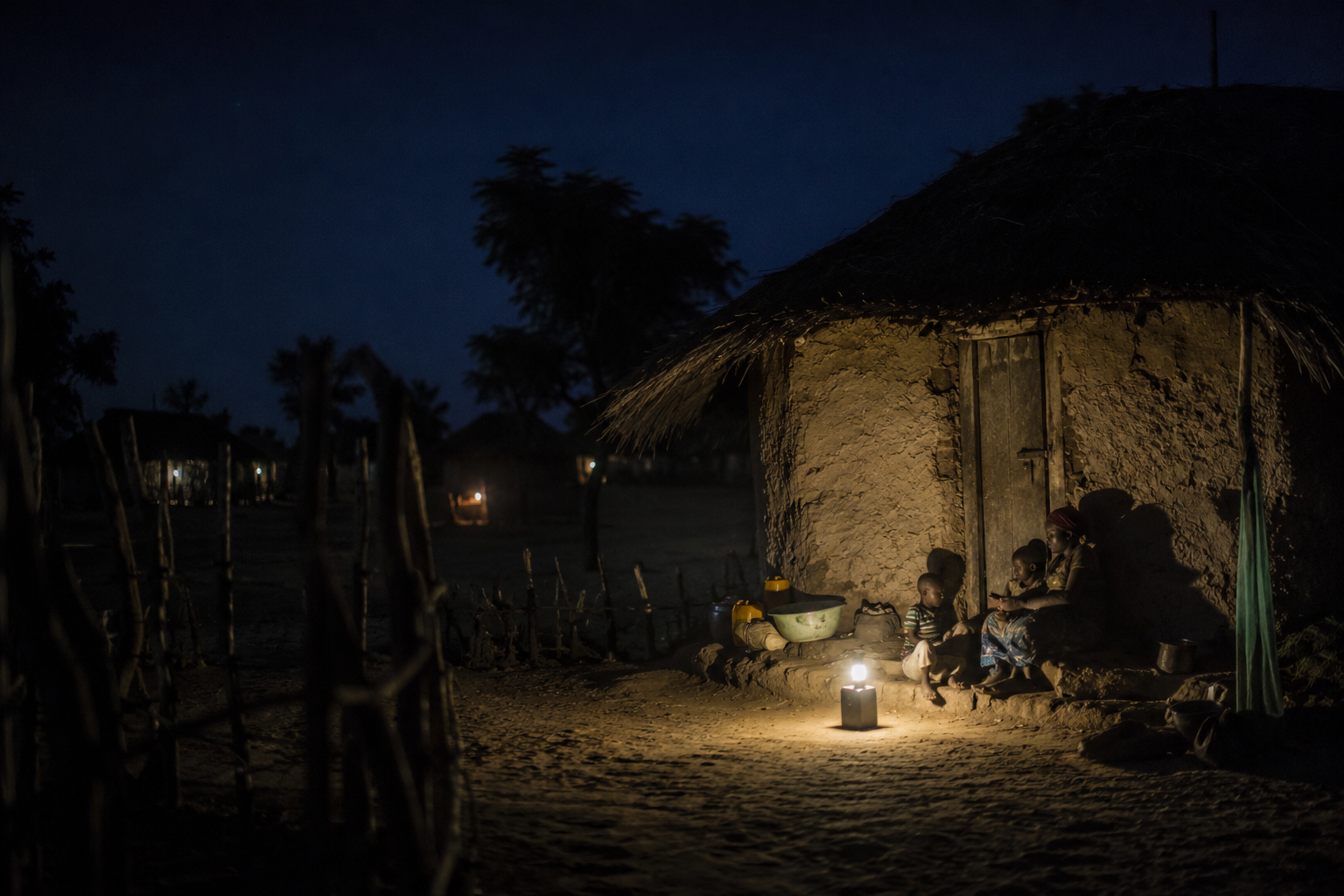
The deficit is also overwhelmingly rural. Globally, 84 percent of people without electricity live in rural areas. In sub-Saharan Africa, urban electricity access has reached approximately 82 percent, while rural access remains closer to 33 percent. Approximately 451 million rural sub-Saharan Africans lacked electricity in 2023. That gap between city and countryside is where the access challenge is actually concentrated, and it explains why progress often appears slower than national statistics suggest. Urban areas gain connections and attract infrastructure investment, while rural communities remain far from transmission networks, making conventional grid extension expensive, slow, and often commercially unviable.
Why the connection count is the wrong metric
The most important finding in recent energy access data may not be the number of people connected, but the quality of the electricity they receive.
IRENA's Off-grid Renewable Energy Statistics 2025 shows that off-grid renewable systems had connected approximately 86 million people worldwide by the end of 2024, with Africa accounting for more than three-quarters of those beneficiaries. Millions of households that previously relied entirely on kerosene, candles, or diesel generators now have basic electricity services.
The same dataset reveals an uncomfortable reality. The majority of off-grid households received under eight hours of electricity per day, sufficient for basic lighting and phone charging, but below the threshold at which productive economic activity becomes possible. A household with four hours of electricity per day is counted as connected, a clinic unable to maintain a vaccine cold chain reliably is counted as connected, and a small business unable to operate machinery consistently is counted as connected. All three appear in the same headline figure.
The World Bank's access framework recognises five tiers of electricity supply, ranging from Tier 1, a few hours of light per day, minimum 3 watts, to Tier 5, equivalent to a grid connection in an advanced economy. The productive economy requires Tiers 4 and 5. The vast majority of off-grid solar connections counted as progress are Tiers 1 or 2. They improve daily life, meaningfully, genuinely, and in ways that matter to the households receiving them, but don't provide the sustained, reliable electricity that supports income generation, agricultural productivity, healthcare delivery, or industrial activity.
This isn't an argument against off-grid solar or against counting connections. It is an argument that connection counts measure only one dimension of a multi-dimensional problem and that the dimension they measure is not the one most consequential for economic transformation.
Why progress is slower than the numbers suggest
Sub-Saharan Africa connected approximately 35 million additional people to electricity in 2023. The region's population grew by approximately 30 million people in the same period. The net improvement was approximately 5 million people. At that rate, the absolute number of people without electricity isn't falling meaningfully because population growth is absorbing most of the gains from new connections.
The comparison with Central and South Asia clarifies the scale of the gap. That region reduced its electricity access deficit from approximately 414 million people in 2010 to just 27 million in 2023, a reduction of more than 90 percent in thirteen years. Sub-Saharan Africa's share of the global deficit moved in the opposite direction over the same period, from 50 percent to 85 percent. The critical variable wasn't technology or resources, but the rate relationship between new connections and population growth, sustained over more than a decade through consistent policy, financing, and institutional coordination.
Under current policies, the IEA projects that 645 million people will still lack electricity in 2030, the year by which SDG7 sets universal access as a target. Eighty-five percent of those 645 million will be in sub-Saharan Africa. The Mission 300 initiative jointly led by the World Bank and the African Development Bank targets electricity access for 300 million people by 2030. Even fully delivered on schedule, it would leave more than 200 million people without access.
The number that actually matters
Africa's electricity access challenge is no longer adequately described by a single headline figure. The 666 million global deficit and the 565 million sub-Saharan African deficit are important baseline measurements, but are not sufficient measurements for designing the policy and financing response the scale of the problem requires.
The number that matters isn't how many people are connected, but the rate at which new connections are being added relative to population growth, and whether those connections provide the hours and capacity of electricity that allow productive economic activity. By the first measure, progress is barely moving in absolute terms. By the second, the headline figures substantially overstate what has been achieved.
Africa doesn't have an electricity access measurement problem. It has a productive electricity access delivery problem. The number most commonly cited counts connections, but the number that matters counts hours, reliability, and capacity, and on that measure, the deficit is considerably larger, and the distance to meaningful transformation considerably further than 600 million suggests.